Travel SEO
Why Travel Brands Need a Different Link Building Strategy
Keir
August 25, 2026 · 7 min read
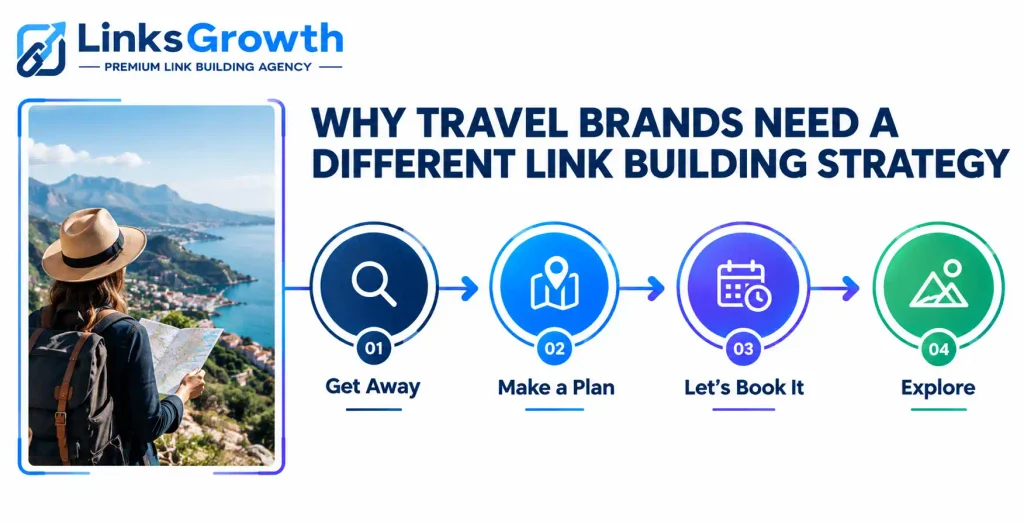

Google’s own research into travel search behaviour identified something most link building strategies still ignore: booking a trip isn’t a single search, it’s a journey spread across weeks, multiple devices, and dozens of individual moments of intent. Google calls these “micro-moments” — I-want-to-get-away, time-to-make-a-plan, let’s-book-it, and can’t-wait-to-explore — and each one behaves differently, gets discovered differently, and needs a different kind of authority behind it.
Most link building agencies never account for any of this. They treat a hotel website the same way they’d treat a local plumber’s site or a SaaS landing page: chase domain authority, build some guest posts, move on. But travel link building genuinely requires a different approach, because travel search itself doesn’t behave like other commercial categories. This guide explains why, using Google’s own published research, real industry data, and what actually works for hotels, tour operators, and tourism brands trying to build authority in a genuinely different kind of market.
Google’s research is unusually specific about this. During the planning phase, search remains the single most common way travellers discover the brand they ultimately book with — not social media, not paid ads, search. That alone makes organic visibility, and the backlink authority that supports it, disproportionately valuable in travel compared to categories where discovery happens elsewhere.
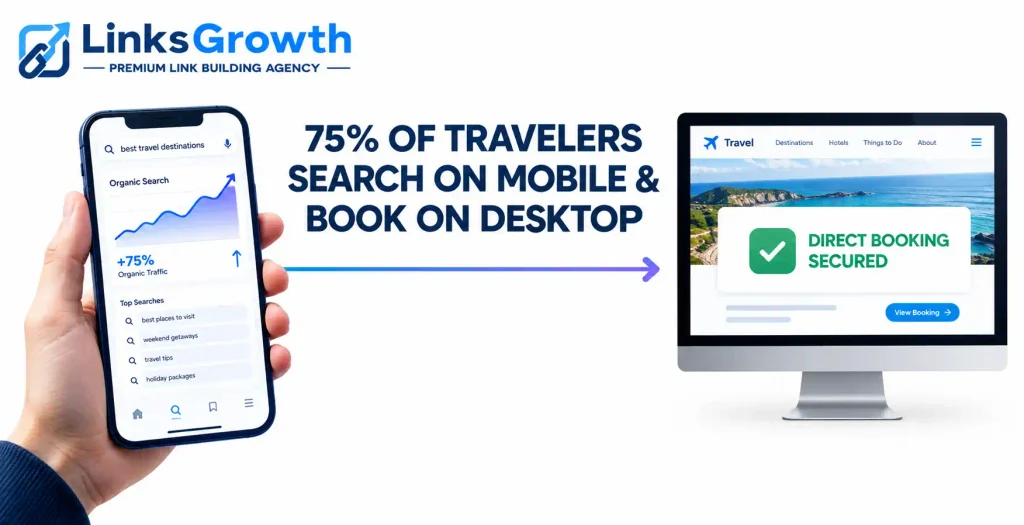
But the behaviour behind that search activity is genuinely unusual. Google’s own multi-device research found that 75% of leisure travellers who shop for hotels on a smartphone end up purchasing on a desktop or laptop, and nearly two-thirds double-check prices on a computer after first shopping on mobile. This isn’t a single-session, single-device purchase decision — it’s a research process stretched across days or weeks, multiple devices, and typically several return visits before a booking is ever made.
Seasonality adds another layer most industries don’t deal with at all. Search demand for coastal destinations rises through summer; ski resort and cold-weather queries take over in winter. A generic B2B or local-service link building calendar has no equivalent to this — travel content and outreach genuinely needs to be timed against demand cycles that shift predictably throughout the year.
A generalist SEO agency applying a one-size-fits-all playbook to a travel client typically defaults to the same tactics regardless of industry: a handful of guest posts, some directory submissions, maybe a press release or two. None of this accounts for what travel purchases actually require.
Booking a hotel, a tour, or a flight is a considered, often high-value purchase decision — closer to buying a car than ordering a takeaway. Travellers researching a destination want proof of genuine authority: coverage in publications they already trust, mentions from travel writers who’ve actually been somewhere, data and insight that couldn’t have been written by someone who’s never left their desk.
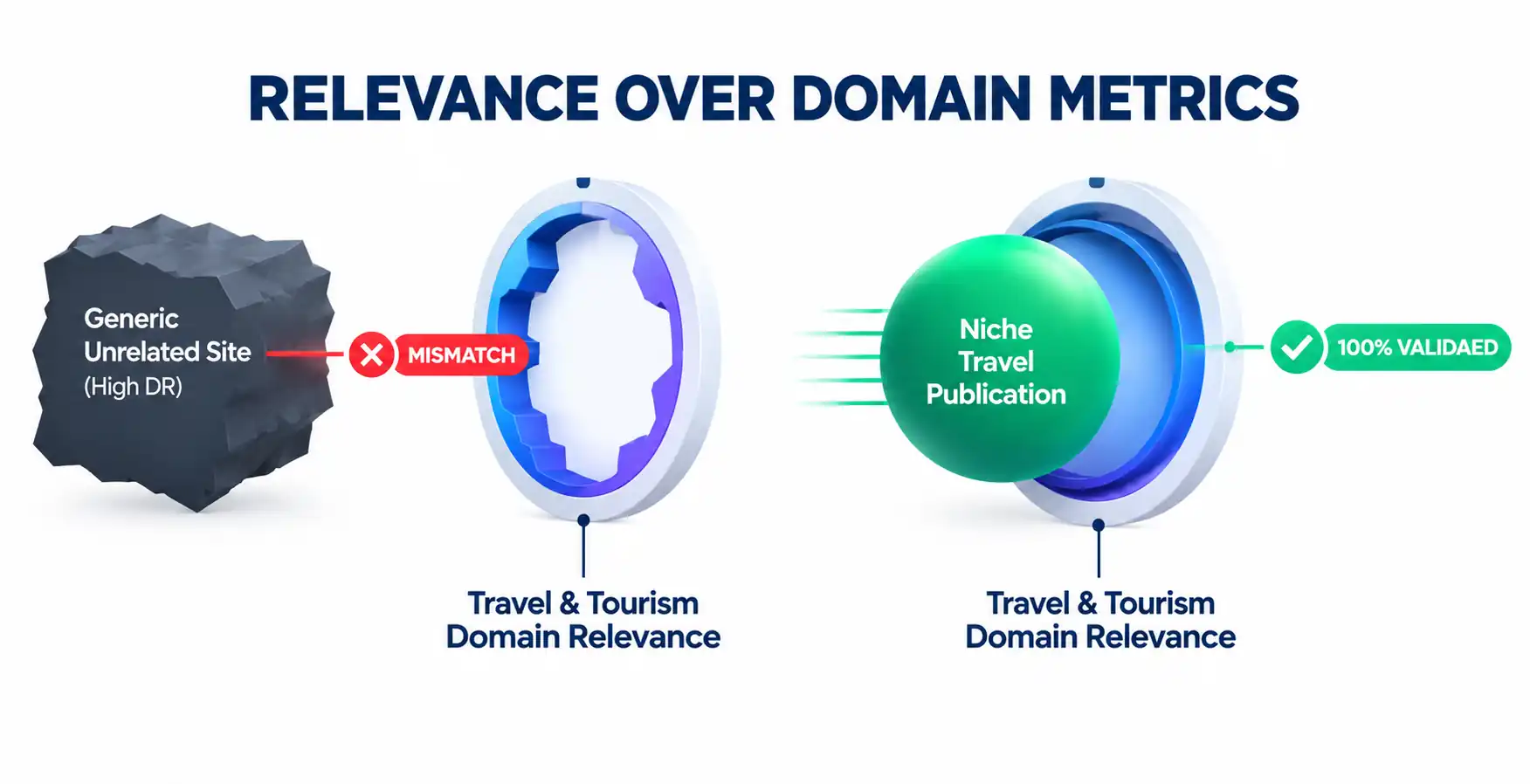
A backlink from an unrelated, generic high-authority site does very little to build that kind of trust, even if it technically passes ranking value. Link building agency for travel sites work needs to be judged by relevance to the travel and hospitality publisher landscape specifically, not by domain metrics alone.
The scale of the industry alone justifies a dedicated approach: travel and tourism is projected to employ up to 430 million people globally by 2033 — roughly one in nine jobs worldwide. That’s an enormous, genuinely competitive publisher and content ecosystem to build authority within, spanning destination guides, travel trade press, tourism boards, review platforms, and travel-focused influencers and video creators.
A few things are specific to this market that a generalist strategy typically misses:
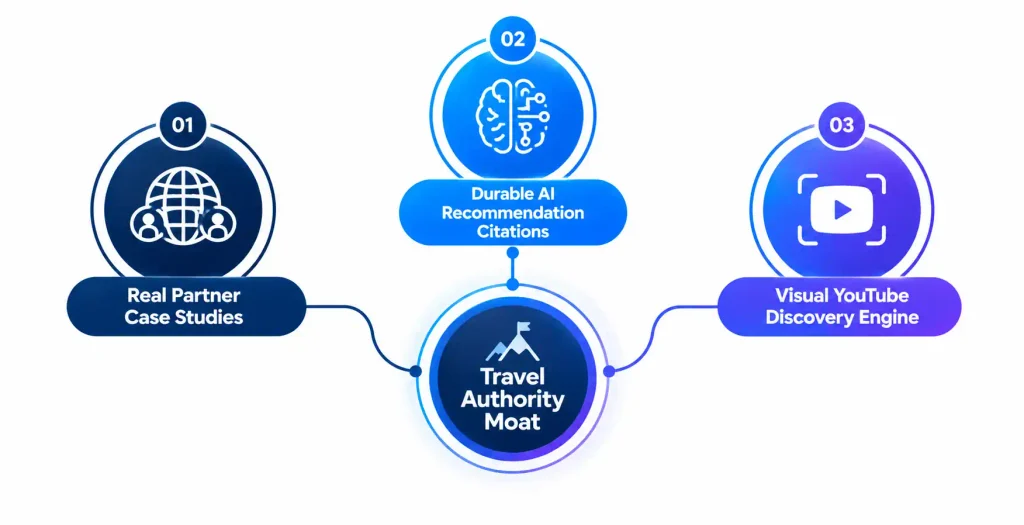
Vendor and partner ecosystems create genuine link opportunities. Hotels and travel brands routinely work with booking platforms, software vendors, event organisers, and destination marketing organisations — many of which publish case studies, partner showcases, or client spotlights. These aren’t manufactured links; they’re a natural by-product of real business relationships, and they’re consistently underused.
Durable editorial coverage now does double duty. A single feature in a well-regarded, high-authority travel publication doesn’t just pass link value — it increasingly gets pulled into AI-generated travel recommendations and summaries too, functioning as a long-running citation rather than a one-off placement. This makes genuinely earned, high-quality travel coverage more valuable over time than it used to be, not less.
Video and visual discovery matter more here than in most industries. Google’s own estimates put roughly 106 million of YouTube’s monthly unique visitors in the “traveller” category, with 64% watching travel content specifically while still deciding where to go. A travel link building strategy that ignores video-based discovery and influencer partnerships is ignoring a substantial share of how the audience actually researches.
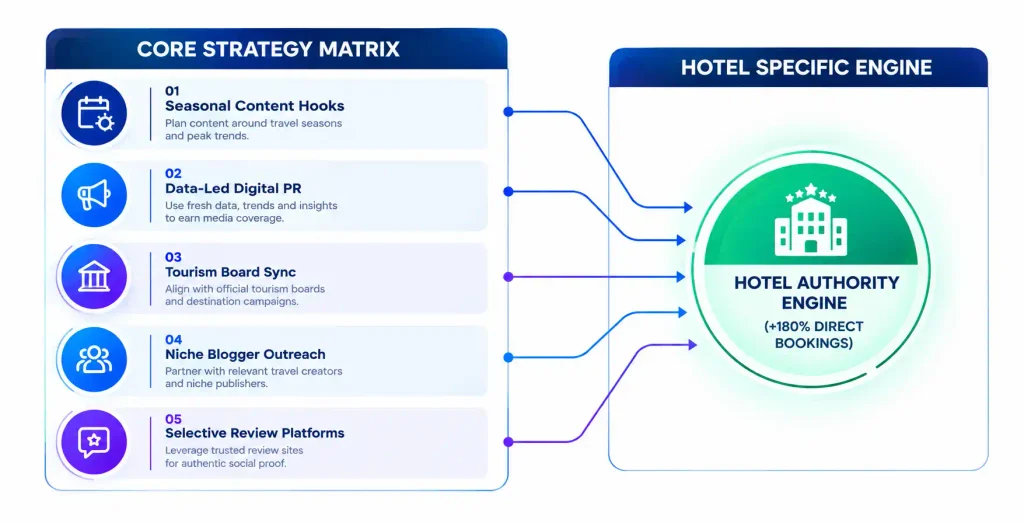
Destination and seasonal content hooks. Building outreach and content around what’s actually in demand each season — rather than a static, evergreen calendar — aligns with how travel search genuinely moves throughout the year.
Original research and data-led digital PR. Proprietary data — booking trend reports, destination popularity benchmarks, traveller survey findings — consistently ranks as one of the most effective tactics across the SEO industry generally, and travel brands are unusually well positioned to produce it, since booking and guest data is a natural by-product of the business itself.
Vendor, partner, and tourism board relationships. Co-marketing with booking platforms, technology vendors, and destination marketing organisations produces genuinely relevant, contextually appropriate links that a directory submission never will.
Travel blogger and niche publication outreach. Smaller, genuinely engaged travel publications and bloggers often deliver more qualified referral traffic and more contextually relevant authority than a handful of large, generic guest posts.
Selective directory and review-platform presence. Not all travel directories carry equal weight. Established, genuinely used platforms that travellers actually consult — rather than generic, low-quality directory networks built purely to house links — contribute real trust signals precisely because real travellers rely on them to make decisions, not just because a link exists.
Hotels have a narrower, more locally-anchored version of this same challenge. Link building strategies for hotels tend to perform best when they combine three elements: local and destination-specific authority (features in guides and blogs covering the specific city or region), genuine review and reputation signals (coverage on established travel review platforms), and visual storytelling (photography and video content pitched to travel publications and social platforms, since hospitality is an inherently visual purchase decision). A hotel group that focused its outreach around exactly this combination — regional travel blog features, review platform authority, and visual content placement — reported a 180% increase in direct bookings following a sustained local SEO and link building campaign, alongside becoming one of the more visible operators in its market. That kind of outcome reflects what happens when outreach is built around the specific way people actually research and book a hotel stay, rather than a generic backlink target applied without context.
A travel link building agency brings something a generalist simply can’t replicate quickly: an existing relationship map of the travel publisher landscape, an understanding of seasonal demand cycles, and enough sector-specific experience to know which outreach angle will actually land with a travel editor versus which one gets deleted on sight.
This matters practically. A generalist agency pitching a travel client to an unrelated business publication, or building links at a flat, unseasonal pace throughout the year, is working against the grain of how travel search and travel publishing actually operate. A travel link building services provider that specialises in the sector starts from an understanding of the four micro-moments, the multi-device research behaviour, and the publisher relationships already built — meaning less time spent re-learning the landscape and more time spent executing within it.
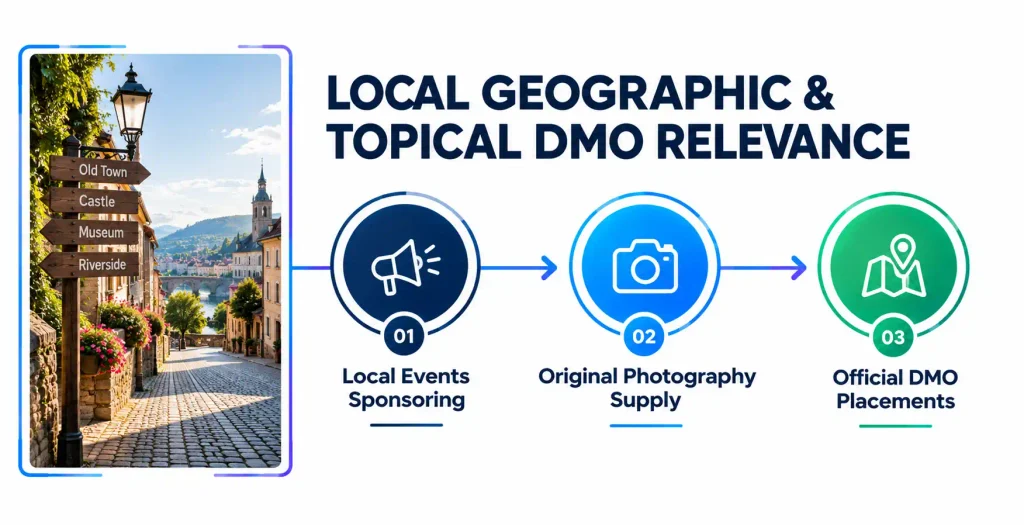
One of the most consistently underused link sources in travel is the destination itself. Regional tourism boards, city-level destination marketing organisations (DMOs), and official visitor sites routinely maintain “where to stay,” “where to eat,” and “things to do” resources — and unlike a generic business directory, a mention here carries genuine geographic and topical relevance that search engines weight accordingly.
These relationships tend to work best as an ongoing dialogue rather than a one-off pitch. Tourism boards regularly need seasonal content, local business spotlights, and event partners, and travel and hospitality brands that show up consistently — sponsoring a local event, contributing genuinely useful visitor information, or supplying original photography — earn placements that a cold outreach email to the same organisation rarely achieves on its own. This is also one of the clearest examples of why a link building agency for travel sites needs genuine sector relationships rather than a generic media list: a DMO contact built over several campaigns is worth considerably more than a fresh cold pitch every time.
Ranking position matters, but it isn’t the only signal worth tracking in a travel-specific campaign, and treating it as the sole metric misses much of what makes travel link building valuable.
Referral traffic quality tells a fuller story than link count alone. A placement on a genuinely relevant travel publication should send visitors who convert at a meaningfully higher rate than generic traffic, precisely because they arrived with travel-specific intent already established.
Direct booking share is a particularly useful metric for hotels specifically, since a stronger organic and referral presence typically reduces reliance on OTA commissions over time — the 180% direct-booking increase referenced earlier is exactly this kind of outcome, not simply a ranking-position change.
Seasonal visibility timing is worth tracking separately from overall ranking trends. A campaign that builds authority ahead of a destination’s peak season, rather than during or after it, captures meaningfully more of the actual demand — which is a travel-specific planning consideration a generic monthly reporting cycle often misses entirely.
Travel is one of the categories most visibly affected by the shift toward AI-generated search summaries and answer engines. Questions like “best area to stay in Lisbon” or “family-friendly hotels near Disney World” increasingly surface AI-generated summaries before a traditional list of blue links ever appears — and those summaries are built by pulling from sources the underlying model already trusts.
This is precisely why durable, high-authority editorial coverage matters more now, not less. A single well-earned feature in a genuinely respected travel publication doesn’t just pass conventional link authority anymore — it becomes a source AI systems repeatedly draw from when generating travel recommendations, effectively functioning as an ongoing citation long after the original placement was published. A brand mentioned by name in enough genuinely authoritative travel content builds the kind of entity recognition that both traditional search rankings and AI-generated summaries increasingly reward.
The practical implication for travel link building agency selection is straightforward: an agency still purely optimising for backlink count, without regard to whether the placement is genuinely citation-worthy, is building for a search landscape that’s already partially out of date. The brands positioning well for what travel search is becoming are the ones earning coverage substantial enough to be worth citing — not just linking to.
Google didn’t build the micro-moments framework as a marketing concept — it built it because travel search genuinely behaves differently from almost every other commercial category, spread across devices, sessions, and weeks of research before a single booking happens. A link building strategy that ignores that difference is working against the grain of how travellers actually make decisions.
The brands that build genuine authority in this space aren’t the ones chasing the highest domain rating they can find. They’re the ones building relevance within the travel ecosystem itself, seasonal content, genuine vendor relationships, and coverage from publishers travellers already trust — which is exactly what a properly specialised travel link building agency is built to do.
It’s grounded in genuine behavioural differences. Google’s own published research shows travel search spans multiple devices and sessions in a way most commercial categories don’t, and demand shifts seasonally in a way that requires a genuinely different content and outreach calendar — not just a difference in tone.
Applying a flat, non-seasonal link building calendar and treating all backlinks as equally valuable regardless of publisher relevance. Travel authority is built through genuinely travel-relevant coverage, not generic domain authority.
Broadly, yes, though the underlying principles overlap. Hotels benefit most from local and destination-specific authority combined with review-platform credibility, while tour operators and OTAs typically need stronger destination-keyword authority through specialised travel media and experience-focused publications.
Similar to other competitive sectors, most travel link building campaigns need several months of consistent, seasonally-aware outreach before ranking movement becomes clear though genuinely newsworthy digital PR content can occasionally earn coverage, and the resulting authority, considerably faster.
Yes, often more so than for large chains. Smaller, independent hotels and operators frequently fit exactly the kind of local, characterful business a destination marketing organisation wants to feature, and the relative absence of competing large-brand budgets in that specific channel makes it a genuinely accessible opportunity.
Focus on destination-specific content, seasonal digital PR, and genuine partnerships with tourism boards, booking platforms, and travel publications. Original research and data-led content (booking trends, destination reports) consistently earns the strongest editorial coverage. Avoid generic guest posting and directory submissions disconnected from the travel niche.
There’s no fixed number — it depends on your specific keyword and what’s currently ranking in your niche. Referring domains matter more than raw backlink count, so check what the weakest page-one competitor for your target term currently has. Competitive destination terms typically need considerably more than long-tail, location-specific queries.
The strongest results come from combining local and destination-specific coverage, genuine review-platform presence, and visual content (photography/video) pitched to travel publications. Vendor and tourism board relationships are consistently underused and often produce more relevant links than cold outreach. Local, geo-specific authority tends to matter more for hotels than broad domain authority alone.
Only selectively — established, genuinely-used platforms travellers actually consult (not generic directory networks built purely to house links) can contribute real trust signals. Quality matters far more than quantity here; a listing on a low-effort, spammy directory adds little and can look manipulative. Stick to directories with real editorial standards and genuine traffic.
Did you find this article useful?