Link Building
Manual Link Building vs Automated Tools: What Actually Works
Keir
August 25, 2026 · 6 min read
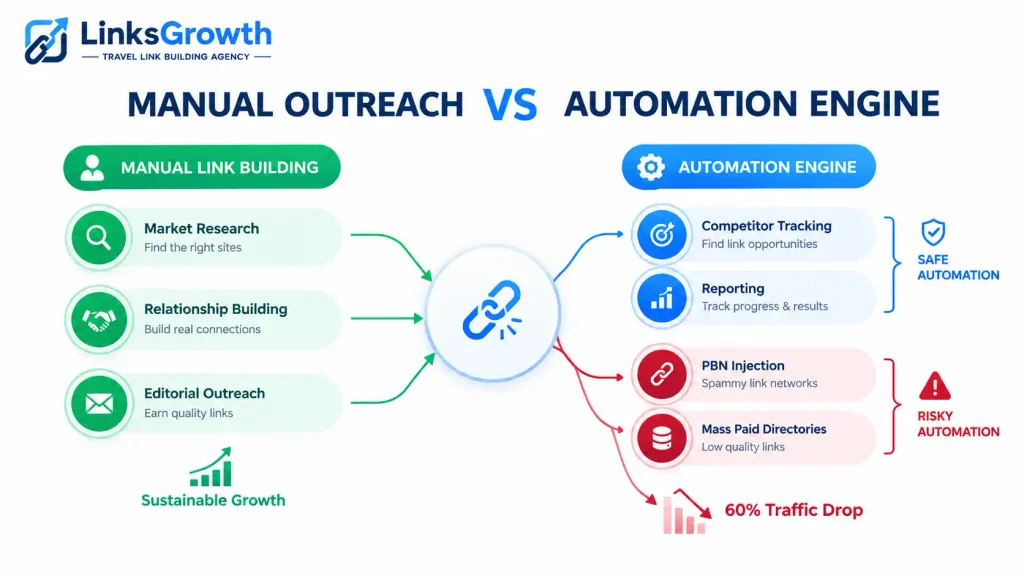

Last year, a business owner watched his site lose 60% of its organic traffic overnight. His previous agency had built over 200 backlinks in three months — an impressive number on paper. The problem was where those links came from: a network of private blog networks (PBNs) and paid directories, placed automatically at scale. Google’s spam detection caught the pattern, issued a manual penalty, and recovery took eight months of disavowing links and rebuilding authority from nothing.
This is the story that keeps repeating across the SEO industry, and it’s exactly why the question “manual link building vs automated tools” isn’t really a close call once you look at the data. But it’s also more nuanced than “automation bad, humans good.” Some automation is not just safe — it’s essential. The distinction that actually matters isn’t whether a tool is involved. It’s what the tool is being used to do.
This guide breaks down what the real statistics show, what Google’s own policies explicitly say about automated linking, where automation genuinely helps, and where it quietly destroys years of ranking progress.
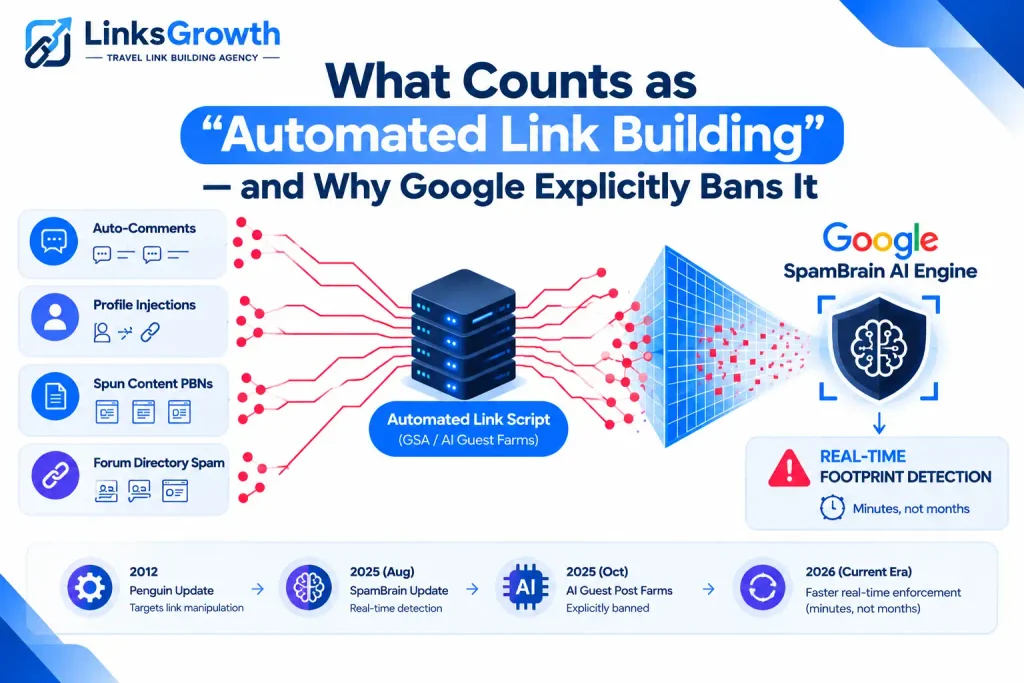
Automated link building refers to any process where software creates, requests, or places backlinks with minimal or no human editorial judgment involved. This includes:
Google’s spam policies are unambiguous on this point: using automated programs or services to create links to a site is explicitly classified as a link scheme, one of the oldest and most consistently enforced categories in Google’s entire spam policy framework. This isn’t a grey area or a matter of interpretation — it’s named directly.
What’s changed isn’t the rule. It’s the enforcement speed. As of the August 2025 spam update, Google’s SpamBrain system can flag suspicious link patterns in real time — in minutes, not the months it used to take. The October 2025 spam update went further, explicitly naming AI-generated guest post farms as their own distinct violation category, closing off a loophole that many “link building services” had been quietly exploiting by rebranding automated link networks as “content marketing.”
The practical result: a tactic that might have worked for a few months in 2019 gets identified and devalued far faster today, often before a client even notices the traffic bump automation was supposed to deliver.
Automated link building tools didn’t appear by accident — they’re a direct response to how early PageRank worked. When Google’s original algorithm essentially counted links as votes, software that could generate thousands of votes automatically was, for a while, genuinely effective. Tools like GSA Search Engine Ranker and XRumer emerged in the late 2000s specifically to exploit that gap, mass-posting links across forums, blog comments, and low-quality directories faster than any human outreach team could.
Google’s Penguin update in 2012 was the first major, public crackdown on this exact behavior — the moment link manipulation, rather than just link volume, became the explicit target. Penguin didn’t just devalue spammy links; for years, it actively penalized entire domains found to be using them, sending countless sites into rankings freefall overnight.
What’s happened since is an arms race that automation keeps losing. Every generation of automated linking tools optimizes for a signal Google’s systems have already learned to detect. SpamBrain represents the current, AI-driven stage of that same fight — and unlike Penguin’s periodic, sometimes-yearly updates, it operates continuously, catching patterns almost as fast as automated tools can generate them.
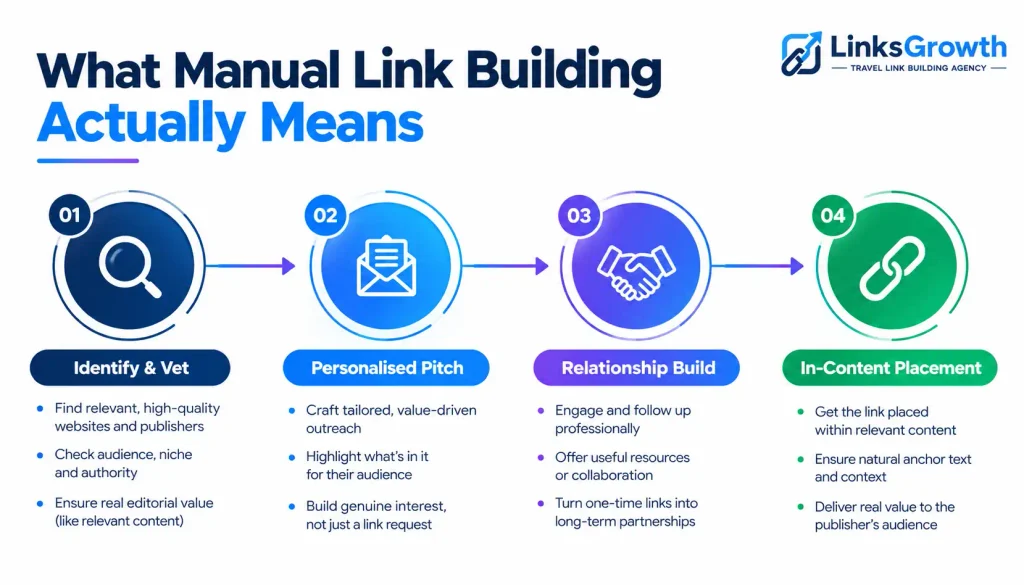
Manual link building is the practice of a real person researching, pitching, and securing a backlink through genuine editorial judgment — identifying a specific, relevant site, understanding what that publication or publisher actually wants, and building a case (or a relationship) for why linking to your content serves their audience.
This looks like:
None of this scales the way automated tools do. That’s not a flaw — it’s the entire reason it still works.
The numbers here are unusually well-documented, and they consistently point the same direction.
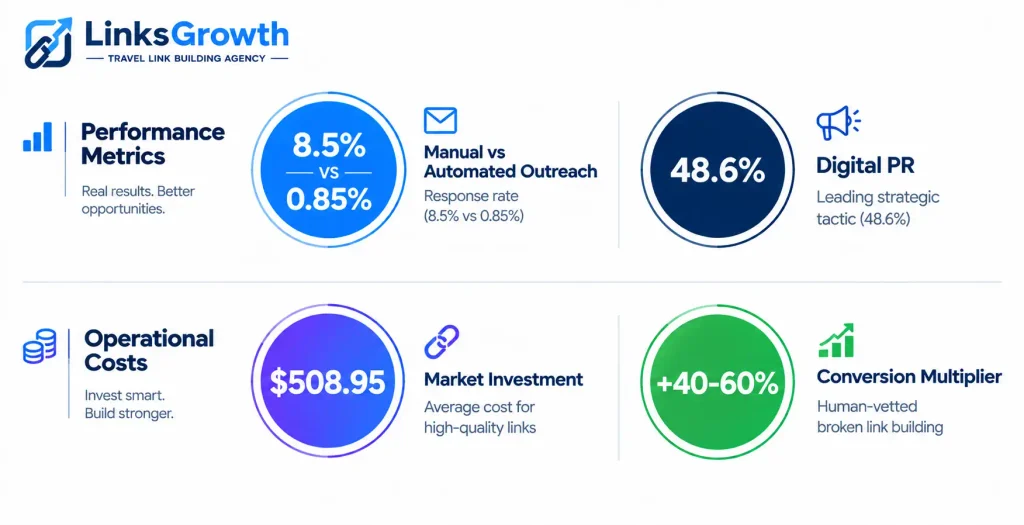
Reply rates tell the first part of the story. Backlinko’s analysis of 12 million outreach emails found that only 8.5% get any reply at all — meaning over 91% of even well-targeted manual outreach gets ignored. That sounds discouraging until you compare it to the automated alternative: BuzzStream’s study of 31 million emails found that large-volume, spray-and-pray campaigns (over 1,000 emails sent with minimal targeting) average just 0.85% reply rates — roughly three times worse than smaller, genuinely targeted outreach. Automation doesn’t just fail to help outreach performance; it actively makes recipients less likely to respond, because generic, unpersonalized pitches are trivially easy to spot and delete.
Effectiveness rankings confirm which tactics actually deliver. In Reporter Outreach’s 2026 survey of 500 SEO professionals, digital PR ranked as the single most effective link building tactic, cited by 48.6% of respondents — well ahead of guest posting (16%) and linkable-asset content (12%). At the opposite end of the same ranking, link exchanges scored 0% as anyone’s top-performing tactic — a technique almost entirely dependent on the kind of reciprocal, semi-automated arrangements Google’s link spam policy specifically targets.
Cost data reflects the same divide. The average cost of a genuinely high-quality backlink now sits at $508.95, according to Editorial.link’s survey of 518 SEO professionals, with 47% of respondents paying $500 or more per link in early 2026. That price reflects real human time: research, relationship-building, and content tailored to a specific publisher. Automated or bulk-purchased links are far cheaper up front — and, as the case study above shows, that upfront saving routinely gets erased many times over in recovery costs.
Broken link building — one of the most manual, judgment-heavy tactics that exists — converts at just 2–5% from outreach to placed link. But when the pitch includes a genuinely well-matched replacement resource rather than generic existing content, that success rate climbs 40–60% higher, according to Backlinko’s data. The technique only works because it requires a human to verify the match is real.
The overnight-60%-traffic-loss story that opened this article isn’t an isolated horror story — it’s a pattern that repeats with remarkable consistency across the industry.
A separate documented case involved a site that had accumulated over 300 toxic backlinks through an agency relying on automated, bulk-purchased placements — the classic “100 backlinks for $50” offers still advertised openly on freelance marketplaces. Once flagged, the disavow-and-recovery process took seven months, during which the site’s organic visibility remained suppressed.
Both cases share the same signature: dozens of links acquired at once, from unrelated or low-quality sites, often with exact-match commercial anchor text — a pattern SpamBrain now identifies almost immediately.
There’s a deeper technical reason these recoveries are so painful. A 2024 leak of internal Google API documentation referenced a signal called “BadBackLinks,” confirming something many SEOs had long suspected but Google had never explicitly stated: spammy or manipulative backlinks can actively harm a site’s performance, not merely get ignored as Google’s public messaging had previously implied. This matters enormously for the automation debate — it means the downside risk of automated link schemes isn’t “wasted effort.” It’s active, measurable damage that has to be manually undone.
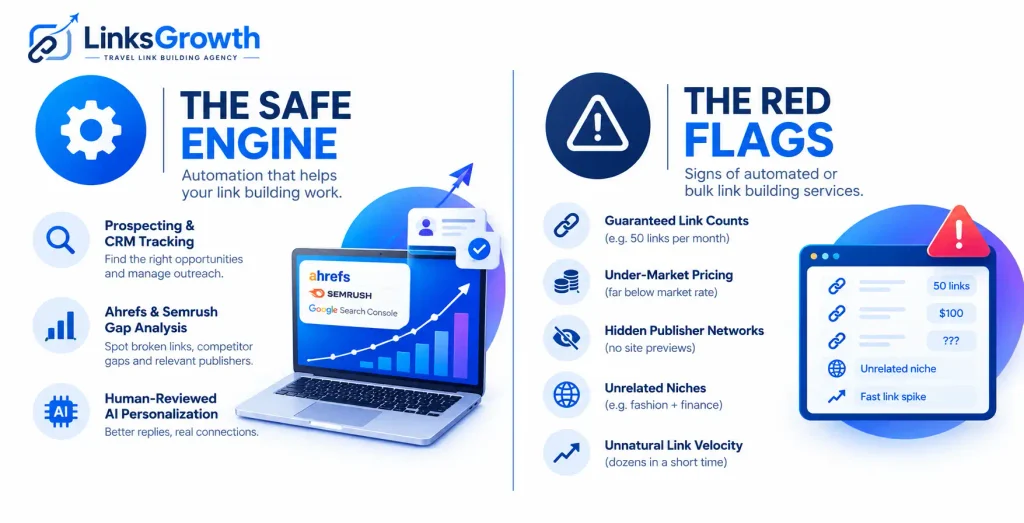
None of this means every tool is dangerous. The distinction that matters is automating the research and logistics of link building versus automating the actual creation or placement of links. The first category is not just safe — it’s standard practice at every serious agency. The second is what triggers penalties.
Legitimate, widely-used automation includes:
The pattern across every legitimate use case is the same: automation speeds up finding and organizing opportunities. It never replaces the human decision about whether a specific link, on a specific site, actually deserves to exist.
Since almost no vendor advertises “we use automated tools to mass-place your links,” the warning signs tend to show up in how a service is sold and reported, not in how it’s described. Worth checking for:
None of these signs guarantee a service is automated, but any combination of two or more is worth treating as a serious red flag before signing a contract.
Google hasn’t been quiet about where it stands on this question.
Gary Illyes, in 2024, stated plainly that Google needs “very few links” to rank pages well — a direct signal that raw link volume was never the goal, regardless of how it’s acquired. This echoes what John Mueller told SEOs years earlier in a Search Central office-hours session, when asked directly whether total backlink count matters: he stated it does not, and that Google’s systems evaluate relevance and quality rather than counting links.
Despite that de-emphasis on volume, links haven’t lost their power as a ranking signal — they’ve simply become far less forgiving of manipulation. Ahrefs’ analysis of one million SERPs still finds referring domains as the strongest single correlating factor with rankings of any metric studied. The message isn’t “links don’t matter.” It’s that the method of acquiring them matters more than it ever has, because Google’s systems have gotten dramatically better at telling the difference between an earned link and a manufactured one.
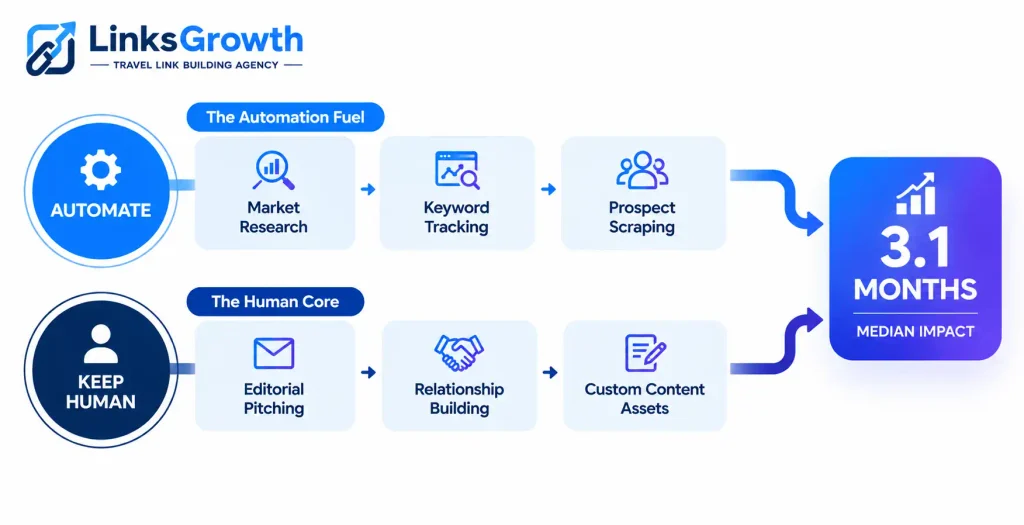
Pulling this together, the practical framework looks like this:
The business owner who lost 60% of his traffic overnight didn’t fail because link building doesn’t work. He failed because the process that built those 200+ links skipped the one thing that actually makes a backlink valuable: a human being deciding it genuinely belonged there.
Automation isn’t the enemy of good link building — bad judgment is, and automation simply lets bad judgment scale faster than it used to. Used to research, organize, and personalize, tools make manual link building faster and smarter. Used to replace the human decision entirely, they build exactly the kind of link profile Google’s systems are now built to find.
Not all automation — automating link creation or placement is. Automating research, prospecting, or outreach tracking is standard, widely-used practice and carries no penalty risk.
Yes, when used to support human judgment rather than replace it — personalizing genuine outreach, for example, rather than generating and sending pitches with no human review.
Detection has become faster, not instant. SpamBrain’s real-time flagging as of the August 2025 update has significantly shortened this window, but some automated schemes still surface briefly before being identified and devalued or penalized.
The data suggests yes: manual, relationship-driven tactics like digital PR consistently rank as the most effective approach in industry surveys, while automated and reciprocal-exchange tactics rank at or near the bottom of effectiveness — with automated schemes carrying genuine penalty risk on top of that.
Far faster than it used to. Historically, manipulative link patterns could take months to surface as a visible penalty. As of the August 2025 spam update, Google’s SpamBrain system can identify suspicious link patterns and begin devaluing them in real time — sometimes within minutes of the pattern forming, rather than the months-long lag SEOs relied on in earlier eras of the algorithm.
Did you find this article useful?