Guest Posting
Guest Posting Best Practices: How to Avoid Low-Quality Placements
Keir
August 25, 2026 · 6 min read

On March 18, 2014, Google’s head of web spam, Matt Cutts, tweeted that the company had “taken action on a large guest blog network.” The target was MyBlogGuest.com — at the time, one of the largest, most established guest blogging platforms on the internet, run by a widely respected figure in the SEO industry. Within hours, the domain vanished from Google’s results entirely. Weeks earlier, Cutts had published a blog post declaring, bluntly, that “guest blogging is done.”
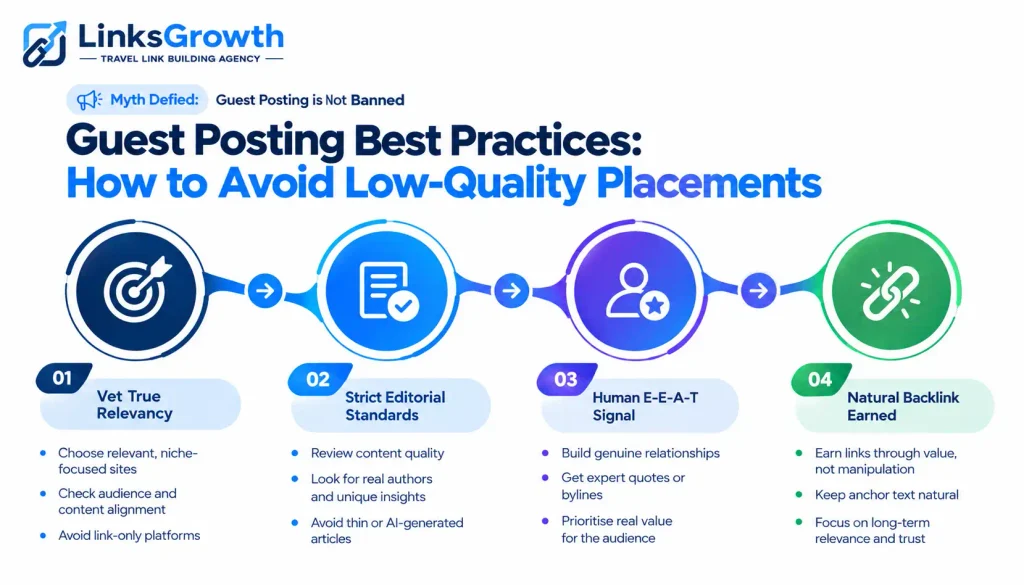
That statement caused genuine panic across the SEO industry — and over a decade later, it’s still frequently misquoted as “Google banned guest posting.” It didn’t. What Google actually targeted, then and now, was guest posting used purely to manufacture links at scale, with no genuine editorial standard behind it. That distinction is exactly as relevant in 2026 as it was in 2014 — if anything, more so, because Google’s detection systems have gotten dramatically faster at spotting the pattern.
This guide covers what genuine guest posting best practices 2026 demands: what separates a valuable placement from a low-quality one, what Google’s current policies actually say, and how to evaluate an opportunity before you publish — not after a penalty forces you to clean it up.
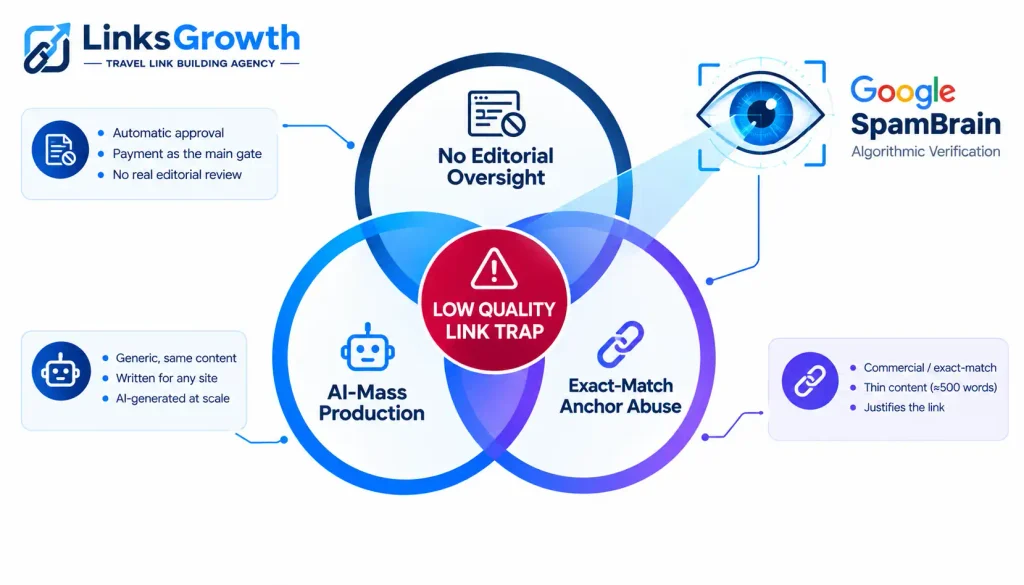
A low-quality guest post isn’t defined by its length, its formatting, or even its writing quality on its own — it’s defined by intent and editorial genuineness. Google’s current spam policies give a precise test for this, formalized under the site reputation abuse policy introduced in March 2024: does third-party content exist primarily to serve the host site’s real audience, or does it exist primarily to borrow that site’s ranking authority for an unrelated party?
This applies whether the content is written by a human contributor or, increasingly, generated at scale by AI. Google’s October 2025 spam update explicitly named AI-generated guest post farms as their own distinct violation category — closing a loophole that many bulk link-building operations had been exploiting by rebranding automated content networks as “content marketing partnerships.”
In practical terms, a guest post is at risk of being classified as low-quality (and therefore a liability rather than an asset) when:
None of these factors alone is automatically fatal. Combined, they form exactly the pattern Google’s spam systems are built to detect.
The MyBlogGuest penalty wasn’t an isolated incident. Around the same time, Google penalized customers of GuestPost Shop, a service that had been paying bloggers to accept guest posts — a case that pulled in a number of established, otherwise-legitimate websites simply for participating in the arrangement.
Cutts’ underlying argument in 2014 remains, almost word for word, the core logic behind guest posting best practices in 2026: guest blogging itself was never the problem. The problem was guest blogging pursued specifically as a scalable link-building tactic, disconnected from genuine editorial value. He was explicit that guest posting for legitimate reasons — audience reach, thought leadership, community building — remained entirely fine. What he objected to was treating it purely as an SEO shortcut.
What’s changed in the twelve years since isn’t the underlying rule. It’s the enforcement mechanism. In 2014, catching a network like MyBlogGuest required a manual Google web spam team investigation. In 2026, Google’s SpamBrain system can identify the same pattern — scaled, low-editorial-standard content built around commercial anchor text — algorithmically, often within the same update cycle it first appears in. The lesson from 2014 didn’t expire. It just started getting enforced automatically.
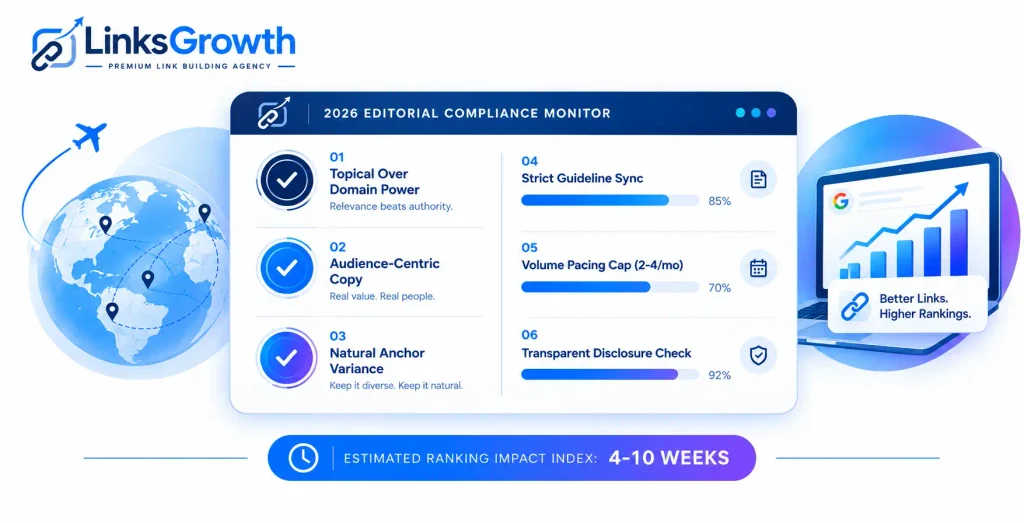
1. Relevance comes before authority metrics. A guest post on a genuinely relevant site with modest traffic will consistently outperform, and outlast, a placement on an unrelated high-DR site. Google’s systems increasingly evaluate topical relevance between the linking content and the destination page as a core quality signal, not just domain authority.
2. Write for the site’s actual audience, not your own funnel. The clearest signal of a low-effort guest post is content that reads like it was written for your own blog and then submitted elsewhere. A genuine guest post should be indistinguishable in quality and tone from the host site’s own best content.
3. Vary anchor text naturally. Guest posts using exact-match commercial keyword anchors in every placement create an unmistakably manipulative pattern. Best practice is a natural mix: branded terms, partial matches, and generic phrases like “this guide” or “further reading” — the kind of language a genuine editorial contributor would actually use.
4. Respect the host site’s own guidelines — every time. Most established sites publish detailed contribution guidelines. Ignoring them isn’t just poor etiquette; it signals to an editor (and, indirectly, to Google) that the pitch was mass-sent rather than genuinely considered for that specific site.
5. Prioritise quality over volume. Industry guidance consistently lands on the same range: two to four thoroughly researched, high-value guest posts per month on genuinely vetted sites outperforms high-volume placement across dozens of lower-quality opportunities. Five guest posts on strong, relevant sites will move rankings more than fifty on weak ones.
6. Disclose paid or reciprocal arrangements properly. If any payment, product, or incentive is involved in securing a placement, Google’s guidelines require the link carry a rel="sponsored" attribute. Editorial fees some publishers charge purely for content review are treated differently from paid link placement — but the moment payment is tied to the link itself, disclosure isn’t optional.
7. Set realistic timeline expectations. Most guest posts begin influencing rankings within four to ten weeks of publication, depending on how quickly the host site is crawled and how established it already is. Anyone promising immediate ranking movement from a guest post is either overselling normal timelines or describing a placement that isn’t genuinely editorial.
Even a genuinely well-matched guest post opportunity can be lost at the outreach stage if the pitch itself reads like the mass-sent template editors reject on sight. A few adjustments make a measurable difference:
Reference something specific about the site. A pitch that mentions a recent article, a particular angle the site covers well, or a genuine gap in their existing content signals the pitch was actually researched — not blasted to a scraped list of hundreds of domains alongside it.
Lead with the idea, not the ask. Editors are inundated with pitches that open by explaining who the sender is and why they’d like a backlink. A pitch that opens with a specific, well-formed content idea — one the editor could imagine running as-is — performs consistently better than one framed around what the pitcher wants to receive.
Keep the outreach list small and targeted. Data on cold outreach broadly supports this: heavily targeted, individually researched pitches consistently outperform high-volume blasts sent to loosely relevant sites, both in response rate and in the quality of sites that actually say yes. A shorter list of genuinely well-matched targets beats a long list of marginal ones.
Don’t ask about the link before the content is agreed. Pitches that lead with anchor text requests or link placement details, before an editor has even agreed to the topic, are an immediate signal that the primary motivation is the link rather than the contribution — exactly the pattern that erodes trust with genuine publishers over time.
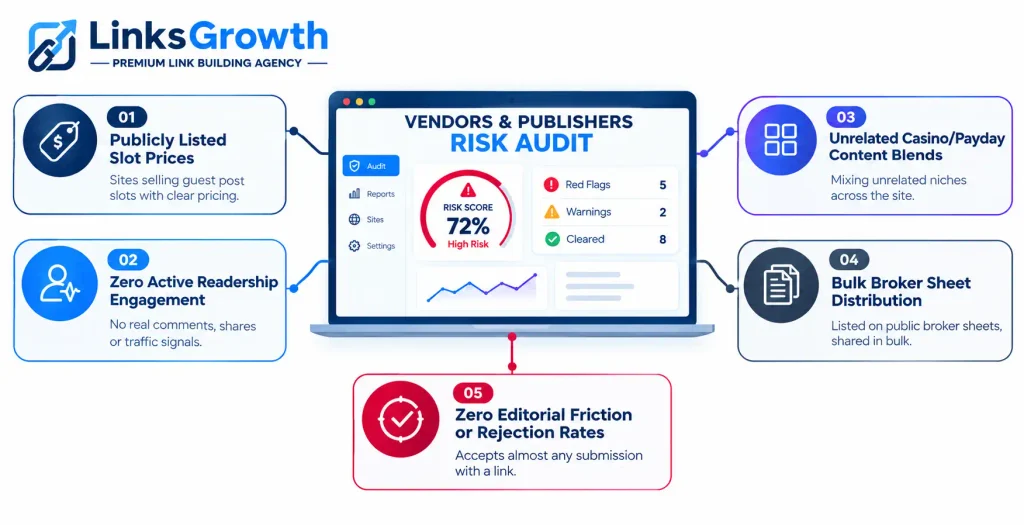
Before agreeing to (or paying for) a guest post placement, a few checks can save months of cleanup later:
If two or more of these apply, the placement is a genuine risk regardless of how attractive the site’s domain metrics look on paper.
Google’s site reputation abuse policy, formalized in March 2024, has produced some of the most visible enforcement actions of the past two years — and guest posting sits directly in its crosshairs whenever third-party content is published purely to exploit a host site’s authority.
Large, previously high-performing sites have been hit hard. Forbes Advisor’s affiliate content operation and CNN’s Underscored product-review vertical both experienced severe visibility losses once enforcement caught up with content that existed primarily to monetize the parent domain’s authority rather than serve its core readership. Underscored reportedly dropped to a small fraction of its previously indexed pages almost overnight.
The direct lesson for guest posting specifically: hosting or contributing to content that exists mainly to pass link value, rather than to genuinely serve an established audience, now carries real, demonstrated risk — not a theoretical one. This applies to the site accepting the guest post as much as the contributor submitting it, which is exactly why vetting a host site’s genuine editorial standards matters as much as vetting your own content quality.
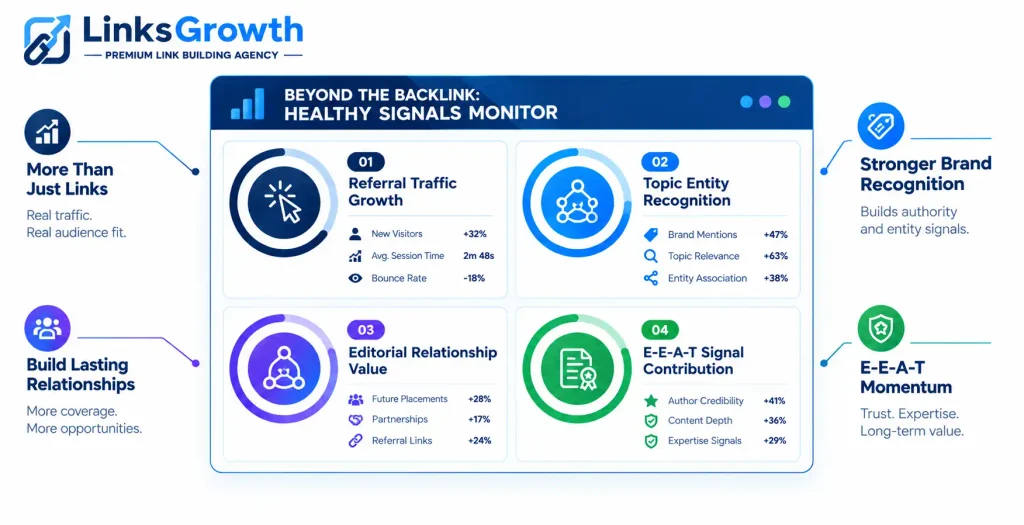
One reason low-quality guest posting persists is that many programs measure success purely by link count, which pushes strategy toward volume over relevance. A genuinely healthy guest posting programme tracks a wider set of signals:
Treating link acquisition as one output among several, rather than the sole objective, tends to produce exactly the kind of genuinely editorial guest posts that hold up under scrutiny — because the content was never built purely to justify a link in the first place.
Google has never claimed guest posting itself violates its guidelines. Its Search Central documentation continues to treat guest posting as a legitimate content format, provided links within it follow the same standards as any other link: earned through genuine editorial merit, properly disclosed if paid or exchanged, and contextually relevant to the surrounding content.
What Google’s spam policies explicitly do target is the pattern guest posting can be misused to create: scaled content abuse (mass-producing guest content, increasingly via AI, purely to house links) and link spam more broadly, when guest posts are placed through automated networks or bulk-paid arrangements rather than genuine editorial review. The 2014 MyBlogGuest case and the 2026 crackdown on AI-generated guest post farms are, functionally, the same enforcement principle applied twelve years apart with a much faster detection system behind it.
Before committing to a guest post opportunity, confirm:
Google’s position on guest posting hasn’t fundamentally shifted since 2014 — it’s simply gotten far better at enforcing it automatically and immediately, rather than waiting for a manual investigation to catch up. The sites and strategies that get penalized today share the exact same signature as MyBlogGuest did over a decade ago: content produced primarily to house links, published at a scale no genuine editorial process could sustain.
The version of guest posting that still works in 2026 looks almost old-fashioned by comparison: fewer placements, genuinely tailored to each host site, built on real editorial relationships rather than bulk outreach. It’s slower. It’s also the only version that was never at risk of becoming this year’s cautionary tale.
Yes — when the site is genuinely relevant, the content is written for its actual audience, and any paid or exchanged arrangement is properly disclosed. The risk was never guest posting itself; it’s guest posting used purely as a scalable link-acquisition shortcut.
There’s no universal number, but a conservative, defensible range is two to four high-value placements per month on genuinely vetted sites, rather than high-volume publishing across whatever sites will accept content.
Paying specifically in exchange for a followed link violates Google’s guidelines and should be avoided or properly disclosed with a rel="sponsored" attribute. Some legitimate publishers charge a genuine editorial or processing fee unrelated to link placement — that’s a different arrangement and generally lower risk, though it’s worth understanding exactly what the fee covers before paying it.
A guest post is original editorial content contributed to a third-party site. A sponsored post is paid placement requiring disclosure. A niche edit inserts a link into content that already exists. Each carries different penalty risk and ranking value, and a genuine link building strategy typically uses a mix of all three, weighted toward the least risky and most editorially genuine options.
Did you find this article useful?