Blog
What Is SEO for Travel Brands? A Quick Guide
Keir
August 25, 2026 · 5 min read

Search remains the single most common way travellers discover the brand they eventually book with, according to Google’s own research into travel planning behaviour. That single fact explains why SEO for travel brands deserves a different, more deliberate approach than SEO for almost any other industry — the businesses that show up consistently across a traveller’s multi-week, multi-device research journey are the ones that ultimately get the booking.
This guide covers what travel SEO actually involves, from the technical foundations through to content strategy, local visibility, and link building — with enough depth to serve as a genuine starting point whether you run a boutique travel agency, a hotel group, a tour operator, or a destination-focused blog.
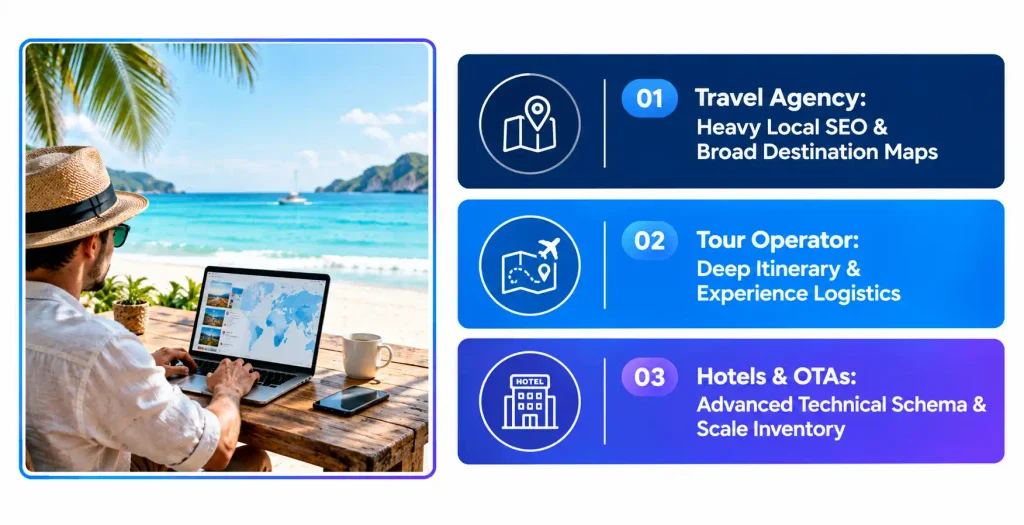
Before going further, it’s worth addressing a question that comes up constantly: does SEO for travel agency businesses genuinely need a different approach than SEO for a hotel, a tour operator, or an airline? The honest answer is that the core principles stay identical, but the emphasis shifts meaningfully depending on the business model.
SEO services for travel agency businesses typically need the heaviest local SEO investment of any travel sub-vertical, since agencies frequently serve a specific region or maintain a physical office, and prospective clients often want to work with someone genuinely local. Content strategy for agencies also tends to prioritise broad destination coverage over deep, single-property detail, since an agency’s value proposition is usually breadth of expertise across many destinations rather than depth on one.
SEO for travel company operators running tours looks different again — content needs to go deep on specific itineraries and experiences rather than broad destination overviews, since the buying decision hinges on the specifics of what’s included, the guide’s expertise, and genuine trip logistics rather than general destination information a traveller could find anywhere.
SEO for travel industry businesses more broadly — encompassing hotels, OTAs, and booking platforms — tends to weight technical SEO and structured data most heavily of all, given the sheer scale of inventory (individual room types, rates, and availability windows) that needs to be both crawlable and genuinely useful to searchers landing on any given page.
Recognising which category your business actually falls into — and resisting the temptation to copy a generic strategy built for a different business model — is one of the highest-leverage decisions in any travel SEO plan.
SEO for travel brands is the practice of optimising a travel-related website — a travel agency, hotel, tour operator, airline, or destination content site — to rank well in search engines for the terms travellers actually use throughout their planning and booking journey. It covers the same broad categories as SEO in any industry (technical performance, on-page content, off-page authority) but applied to a market with genuinely unusual search behaviour behind it.
The distinction matters in practice, not just in theory. SEO for travel agencies specifically needs to account for high-consideration purchase decisions researched over days or weeks, strong seasonal demand swings, and a search journey that frequently spans several devices before a booking is ever completed. A generic SEO strategy applied without adjusting for any of this typically underperforms, even when the technical execution is otherwise solid.
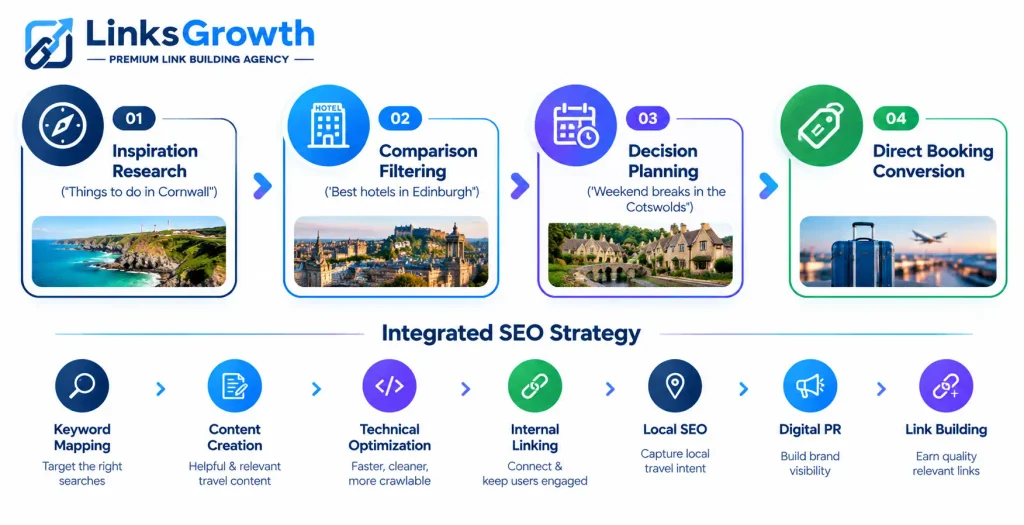
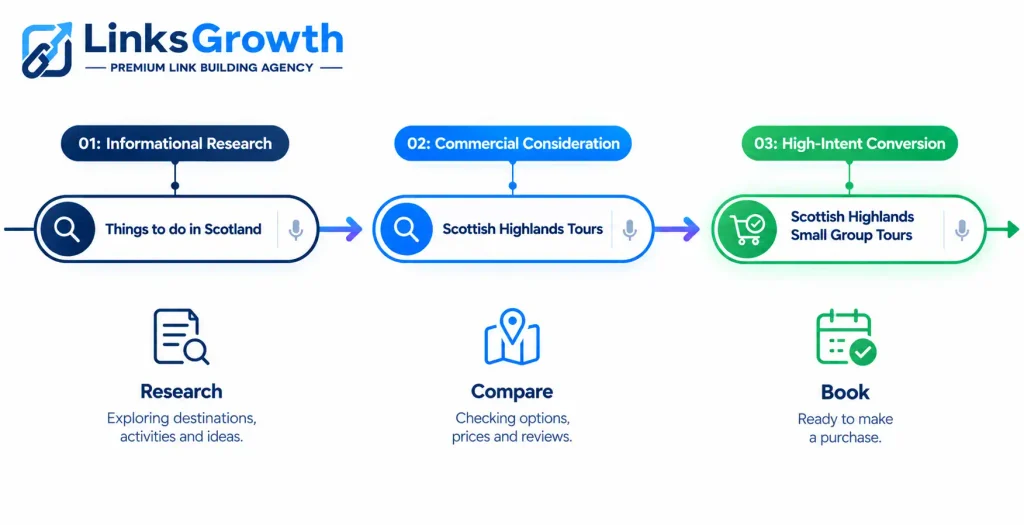
Google’s own travel research identified four distinct stages travellers move through — dreaming about a destination, actively planning, booking, and finally experiencing the trip — and each stage carries different search intent, different content needs, and different competitive dynamics. A travel SEO strategy built around a single, generic keyword list misses the fact that “best beaches in Portugal” and “book flight to Lisbon” represent completely different points in the same customer’s journey, weeks apart.
Multi-device behaviour compounds this. Google’s research found that a majority of travellers who begin researching hotels on a smartphone ultimately complete their purchase on a desktop or laptop, often after multiple return visits. This means visibility needs to be consistent and genuinely trustworthy at every touchpoint, not just optimised for a single conversion-focused landing page.
Seasonality is another factor with few direct equivalents outside travel. Search demand for coastal destinations climbs through spring and summer; ski and winter-sun queries take over from autumn onward. SEO for travel websites genuinely needs a content and technical calendar built around these predictable demand cycles, rather than a static, evergreen approach.
Finally, trust signals matter more here than in many categories. Booking a holiday or a significant trip is a meaningful financial commitment, and travellers are unusually sensitive to signs of genuine expertise and credibility — which is precisely what Google’s E-E-A-T framework (Experience, Expertise, Authoritativeness, Trustworthiness) is designed to reward, and precisely where a lot of thin, generic travel content falls down.
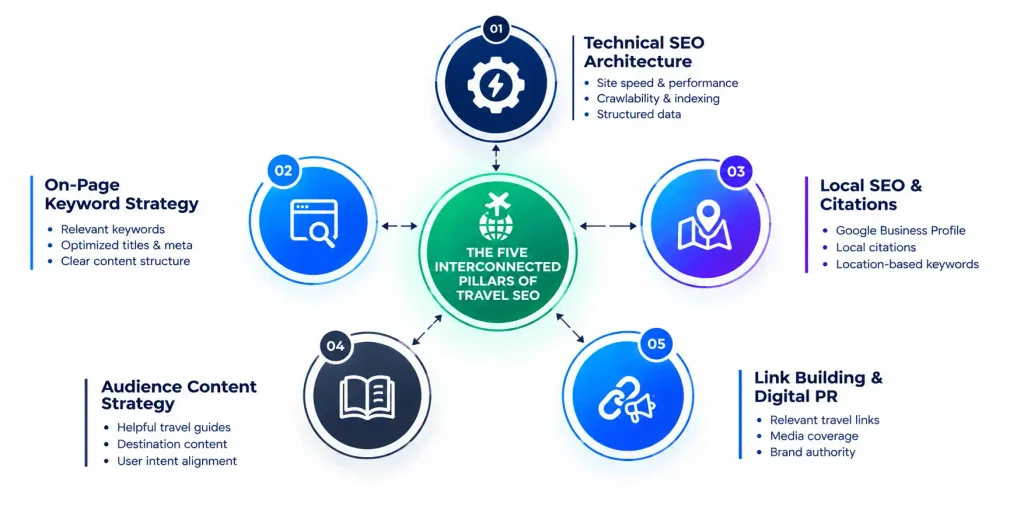
Before going deep on any single area, it helps to see the full picture. Effective SEO for the travel industry rests on five interconnected pillars:
Technical SEO — site speed, mobile performance, and structured data, all disproportionately important given how much travel research happens on mobile devices with variable connection quality.
On-page content and keyword strategy — building genuinely useful destination, itinerary, and booking content structured around real search intent at each stage of the travel journey.
Local SEO — critical for travel agencies, tour operators, and hospitality brands with a genuine local or regional presence, where Google Business Profile visibility and local citations directly influence bookings.
Content strategy — the ongoing production of destination guides, seasonal content, and original research that both ranks well and genuinely helps travellers plan.
Link building and digital PR — earning the kind of authority signals covered in depth elsewhere on this site, since travel’s publisher landscape (destination guides, travel trade press, tourism boards) offers genuinely different opportunities than most other industries.
Each of these deserves its own detailed treatment, which the following sections walk through in turn.
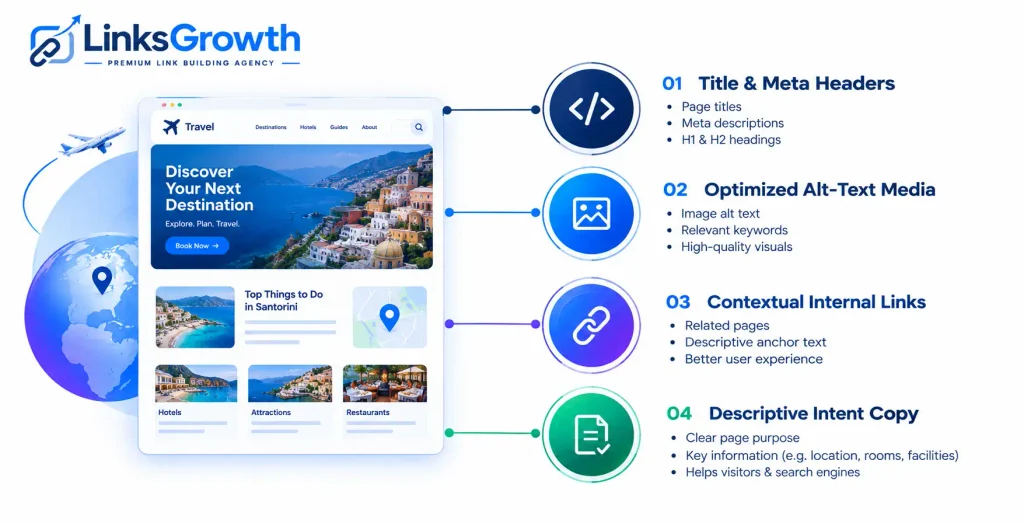
Keyword mapping by travel journey stage is the foundation. Dreaming-stage content (“things to do in Kyoto,” “best time to visit Iceland”) should be structured differently from booking-stage content (“Kyoto ryokan availability,” “flights to Reykjavik in March”) — both in the depth of information provided and in the calls to action used. Mapping your existing content against these stages usually reveals significant gaps, typically an overabundance of booking-focused pages and a shortage of genuinely useful planning content.
Destination and itinerary page structure benefits from clear, scannable formatting — practical information (best time to visit, how to get there, what to budget) presented alongside genuinely useful narrative content, rather than either extreme alone. Pages that read purely as marketing copy tend to underperform against pages that balance promotion with real, practical planning value.
E-E-A-T signals matter more in travel content than in many categories, given the trust and financial stakes involved. This means visible author credentials (has the writer genuinely visited the destination or run the tour described?), transparent, up-to-date pricing and availability information, and genuine first-hand detail rather than generic, could-apply-to-anywhere descriptions.
Internal linking between journey stages is frequently overlooked. A dreaming-stage blog post about a destination should link naturally toward relevant planning and booking content, guiding a reader through their own research journey rather than leaving them to search again from scratch. This single structural change often meaningfully improves both user engagement and the ranking performance of deeper, booking-focused pages.
Generic keyword research tools work fine as a starting point, but travel keywords for SEO genuinely benefit from a structured approach layered on top of standard volume-and-difficulty research.
Map keywords to journey stage first, then to volume. A high-volume dreaming-stage term and a lower-volume but highly commercial booking-stage term serve completely different purposes, and treating them as directly comparable on a single priority list misleads more than it helps. Build separate keyword sets for each stage of the journey rather than one undifferentiated list.
Prioritise destination and modifier combinations over single head terms. Genuine travel search volume concentrates heavily in long-tail, destination-specific phrasing — “best time to visit,” “things to do in,” “how to get to” combined with a specific place name — rather than in unmodified generic terms, which tend to be dominated by large OTAs and travel media regardless of a smaller brand’s content quality.
Track seasonal search volume separately from annual averages. A keyword tool’s default annual average volume figure can significantly understate genuine peak-season opportunity, since travel search concentrates heavily into specific months for any given destination. Reviewing monthly trend data specifically, rather than relying on an averaged annual figure, avoids under-resourcing content ahead of a destination’s actual peak demand window.
Don’t ignore genuinely low-volume, highly specific terms. Individually small search volumes across dozens of highly specific itinerary or destination-combination queries frequently add up to meaningful aggregate traffic, and these narrower terms are typically far less competitive than the handful of high-volume head terms every competitor is already chasing.
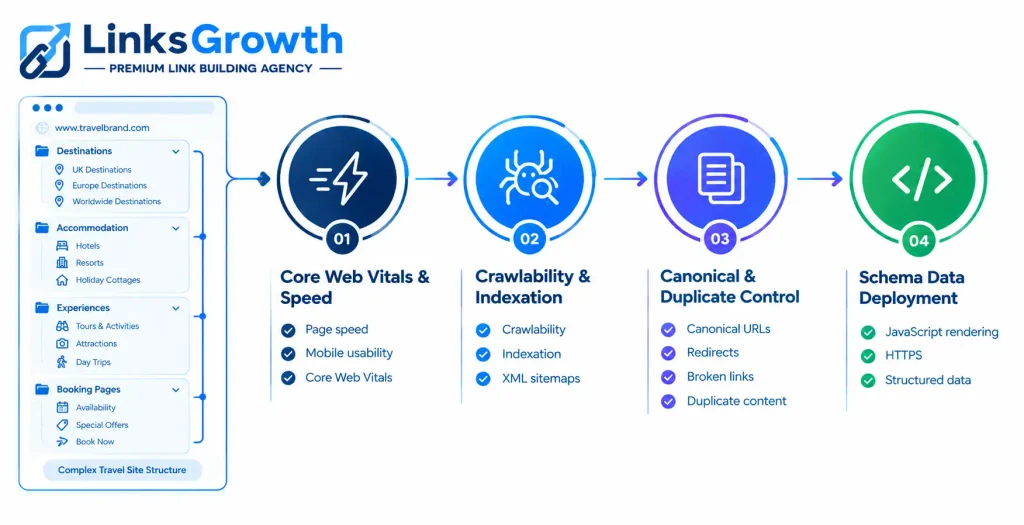
Page speed carries extra weight in travel. With such a high share of travel research happening on mobile, often on variable connections while travelling or commuting, a slow-loading site loses considerably more potential bookings than the same performance issue would cost a desktop-first business. Core Web Vitals performance deserves particular attention on image-heavy destination and property pages, which are common culprits for poor load times.
Structured data is genuinely valuable for travel-specific search features. Schema types like Hotel, TouristAttraction, FAQPage, and Event markup help search engines understand and surface travel content in rich results — star ratings, price ranges, and availability information displayed directly in search results, which meaningfully improves click-through rates against competitors without it.
Multi-currency and multi-language considerations apply to any travel brand serving an international audience. Proper hreflang implementation, correctly localised currency and date formatting, and genuinely translated (not machine-translated) content for key markets all affect both rankings and conversion once a visitor arrives.
Image optimisation deserves specific attention given how visually-driven travel content inherently is. Properly compressed, correctly sized, and thoroughly alt-tagged images support both page speed and image search visibility — a genuinely significant discovery channel for destination and hospitality content that’s easy to neglect.
For travel agencies, agents, and tour operators with any physical or regional presence, local SEO deserves dedicated attention separate from broader content strategy.
Google Business Profile optimisation is the foundation — accurate categories, complete service descriptions, regularly updated photos, and genuine, actively-managed review responses all directly influence local visibility. SEO for travel agents operating from a physical office or serving a specific region should treat this profile as seriously as the website itself, since it’s frequently the first thing a prospective client sees.
Local citations and directory presence still matter, provided they’re genuinely relevant, established platforms rather than low-quality directory networks. Consistency of business name, address, and phone number across every listing remains a basic but frequently overlooked ranking factor.
Genuine review management carries particular weight for travel agencies given how heavily prospective clients weigh social proof before committing to a significant purchase. Actively encouraging satisfied clients to leave detailed reviews, and responding thoughtfully to every review received, contributes meaningfully to both local rankings and conversion.
Location-specific landing pages, for agencies serving multiple regions or specialising in multiple destinations, allow each significant service area or destination speciality to rank independently, rather than competing for visibility on a single generic homepage.
Genuinely useful destination guides consistently outperform generic, could-be-anywhere content. Specificity is the differentiator: practical logistics, honest trade-offs between options, and detail that only comes from genuine research or first-hand experience.
Seasonal content planning, built around the predictable demand cycles covered earlier, should be developed and published well ahead of peak search interest — content published as a destination’s season begins has already missed a meaningful share of the research window competitors captured earlier.
Original research and data-led content — booking trend reports, destination popularity data, traveller survey findings — serves double duty: it genuinely helps readers make informed decisions, and it’s precisely the kind of content that earns organic citations and backlinks from other publishers, which is covered in far more depth in our dedicated guides on travel digital PR and link building strategy.
Video content deserves serious consideration given how significant a discovery channel it’s become for travel planning specifically — a substantial share of YouTube’s monthly visitors research travel content there, much of it during the earliest, most undecided stage of planning a trip. Travel brands without any video presence are absent from a meaningfully large share of how modern travellers actually research.
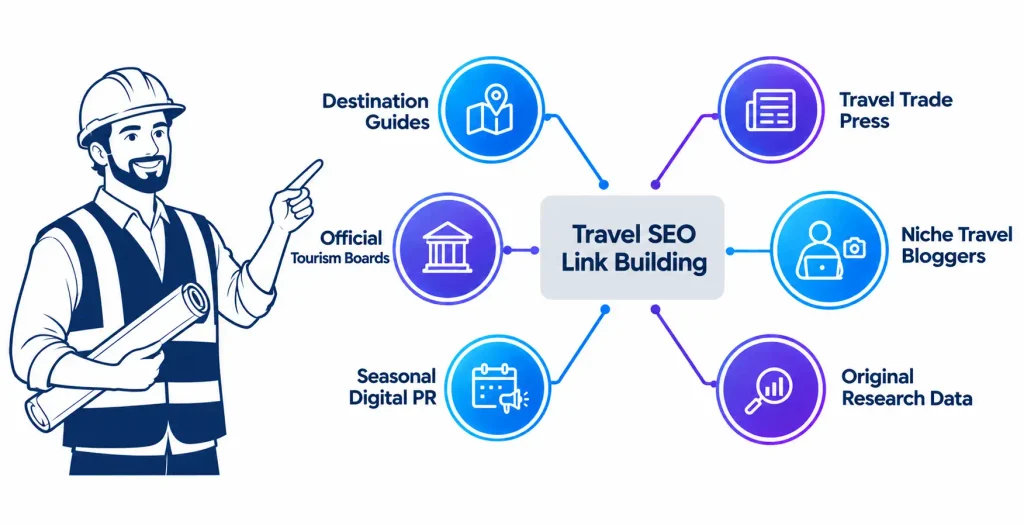
Off-page authority remains a core pillar of any effective travel SEO strategy, though the specifics deserve more depth than a single section here can cover properly. In brief: travel’s publisher landscape — destination guides, travel trade press, tourism boards, and travel-focused bloggers and influencers — offers genuinely different, often more accessible link building opportunities than most other industries, particularly through original research and seasonal digital PR.
For a full breakdown of what actually works here, including real cost and effectiveness data for digital PR versus traditional link building specifically, see our dedicated guides on why travel brands need a different link building strategy and digital PR versus traditional link building, both of which go considerably deeper into this pillar than an overview guide reasonably can.
Independent travel content creators face a genuinely different set of priorities than commercial travel brands, even though many of the underlying mechanics overlap. SEO for travel bloggers typically depends far more heavily on content depth, personal authority, and genuine first-hand experience than on the technical and local SEO investment a commercial agency or hotel needs.
Monetisation model shapes strategy meaningfully here. A blogger earning primarily through affiliate links and sponsored content benefits most from ranking on high-intent, comparison-style content (“best travel insurance for backpackers,” “which Eurail pass should you buy”), while a blogger building a media or advertising-revenue model benefits more from broad-reach, top-of-funnel destination content that maximises overall traffic volume rather than narrow commercial intent.
E-E-A-T genuinely matters more for independent creators than for larger, more established commercial sites, since a blogger’s entire credibility rests on demonstrable, genuine first-hand experience — dates of travel, specific personal detail, and original photography all meaningfully outperform generic, could-have-been-written-without-visiting content, both for readers and for Google’s quality systems.
Most travel brands eventually face a build-versus-buy decision on SEO capability, and the right answer depends heavily on scale and existing in-house expertise.
In-house teams make the most sense for larger travel brands with enough ongoing content and technical work to justify dedicated headcount, and where deep, ongoing product and destination knowledge genuinely benefits from sitting inside the organisation rather than being briefed to an external partner repeatedly.
Specialised SEO services for travel industry businesses typically make more sense for small-to-mid-sized agencies, independent hotels, and tour operators, where the volume of ongoing work doesn’t yet justify a full in-house team, but where genuine travel-sector experience meaningfully outperforms a generalist SEO provider unfamiliar with the industry’s specific behaviour and publisher landscape.
Whichever route you choose, the same evaluation questions apply: does the team or provider demonstrate genuine understanding of travel’s seasonal demand cycles, multi-device research behaviour, and E-E-A-T sensitivity — or are they applying a generic SEO playbook to a travel client without meaningfully adjusting it? The difference in outcomes between the two approaches is usually substantial.
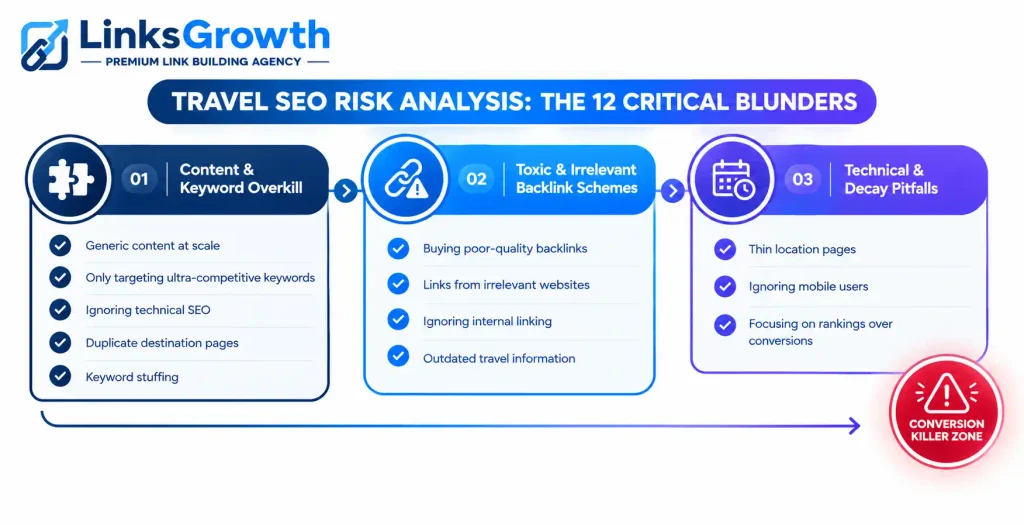
Treating every page the same regardless of journey stage. Applying identical keyword targeting, content depth, and calls to action across dreaming-stage and booking-stage content wastes the natural intent differences between them.
Ignoring seasonality in content planning and technical maintenance. Publishing seasonal content reactively, after demand has already begun climbing, consistently underperforms against content published proactively ahead of the season.
Neglecting mobile performance. Given how much travel research happens on mobile, treating mobile as a secondary consideration behind desktop design remains a surprisingly common and costly mistake.
Generic, interchangeable destination content. Content that could describe any similar destination with a simple find-and-replace of the place name consistently underperforms against genuinely specific, well-researched alternatives — and increasingly struggles against Google’s quality systems too.
Underinvesting in link building and digital PR relative to on-page work. Many travel brands invest heavily in content and technical SEO while treating off-page authority as an afterthought, despite it remaining one of the strongest ranking correlates across virtually every industry, travel included.
Ranking position alone tells an incomplete story in travel, where the actual purchase often happens weeks after the first relevant search. A fuller measurement framework includes:
Visibility across journey stages, tracked separately rather than as a single blended metric — dreaming-stage content and booking-stage content should be measured against different keyword sets and different success criteria.
Direct booking share, particularly relevant for hotels and tour operators looking to reduce dependency on commission-charging third-party platforms over time.
Assisted conversions, recognising that a dreaming-stage blog post rarely gets last-click credit for a booking that happens weeks later, even when it played a genuine role in the decision.
Seasonal performance timing, measured against when demand actually peaks for each destination or service, rather than judged purely against a generic monthly reporting cycle that doesn’t account for travel’s naturally uneven demand curve.
SEO for travel brands isn’t fundamentally different from SEO elsewhere in its core mechanics — technical performance, genuinely useful content, and earned authority all matter exactly as much as they do anywhere else. What’s different is the behaviour behind travel search itself: longer, more considered, spread across devices and weeks, and unusually sensitive to genuine trust and expertise signals given the financial stakes involved.
Getting this right means building every pillar — technical foundations, journey-stage content, local visibility, and genuine off-page authority — around that behaviour specifically, rather than applying a generic strategy and hoping travel’s particular quirks don’t matter. They do, and the brands that plan around them consistently outperform the ones that don’t.
It covers technical site performance, keyword-mapped content built around different stages of the travel planning journey, local SEO for agencies with a physical or regional presence, and off-page authority through link building and digital PR — all adjusted for travel’s unusually long, multi-device research behaviour.
Costs vary considerably based on competitiveness and scope, but travel is a genuinely competitive category given its scale, so meaningful investment in content, technical work, and link building is generally required to compete for anything beyond long-tail, low-competition terms.
Most travel SEO campaigns need several months of consistent work before meaningful ranking movement becomes visible, with results typically compounding over six to twelve months — a timeline that reflects both the competitiveness of the category and the genuinely long research cycle travellers go through before booking.
Yes, often more so than larger competitors — smaller, specialised operators frequently have the advantage in local SEO and niche destination content, where large, generic competitors struggle to compete on specificity and genuine local expertise.
Travel agents typically need stronger local SEO and commercial, booking-intent content, since they’re converting a specific regional or destination-focused audience into paying clients. Travel bloggers generally prioritise broader content depth and personal authority, since their model depends on traffic volume and demonstrable first-hand expertise rather than local service delivery.
It depends on scale. Larger travel brands with enough ongoing content and technical work to justify dedicated headcount often benefit from an in-house team’s deep product knowledge, while smaller agencies, hotels, and tour operators typically get more value from a specialised travel SEO provider than from either a generalist agency or an under-resourced in-house effort.
Did you find this article useful?