Link Building
White Hat Link Building: What It Is and Why It Still Works in 2026
Keir
August 25, 2026 · 7 min read

Google rolled out seven confirmed spam updates between October 2023 and August 2026 — and the pace has only accelerated, with rollouts now landing roughly every six to seven weeks. Sites leaning on manipulative backlinks have taken real, measurable hits during that stretch. Yet through every single one of those updates, one category of link building has come out the other side untouched, or even stronger: white hat link building.
That’s not a coincidence, and it’s not marketing spin. It’s a direct consequence of how Google’s spam-detection system, SpamBrain, actually works. This guide breaks down exactly what white hat link building is, why it continues to hold up while manipulative tactics keep getting caught, which techniques genuinely work in 2026, and what separates a real white hat link building service from one that’s putting your site at risk.
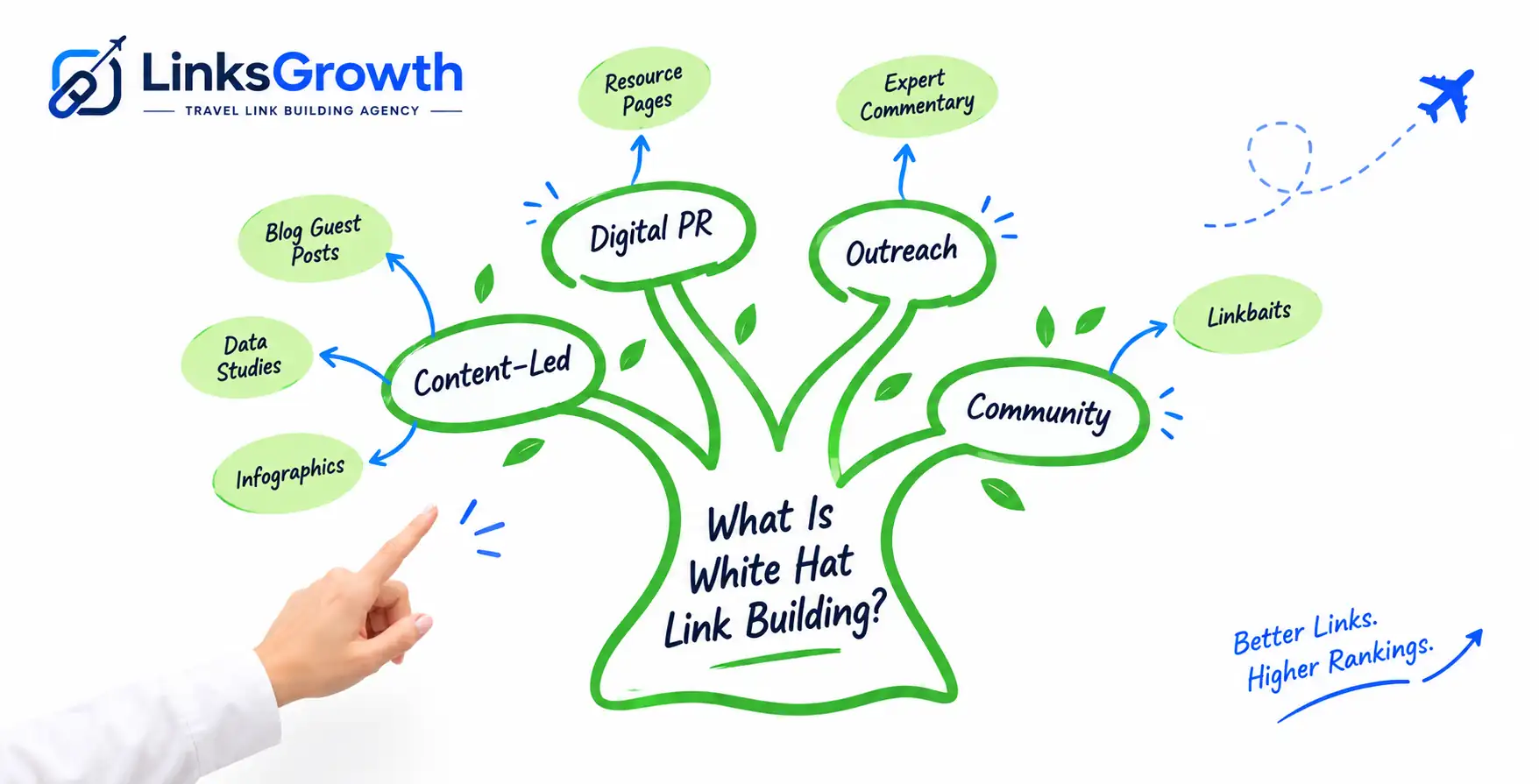
White hat link building is the practice of earning backlinks through legitimate, editorially-driven means — content, relationships, and genuine value — rather than through payment, manipulation, or artificial schemes designed purely to move a ranking needle.
The term borrows from old Western films, where the “good guy” wore a white hat and the villain wore black. In SEO, the distinction works the same way: white hat techniques align with what Google’s own guidelines explicitly permit and encourage, while black hat techniques work against those guidelines, often successfully in the short term, until an algorithm update or manual review catches up with them.
A genuinely white hat backlink shares a few consistent traits:
This is the foundation any legitimate white hat link building service should be built on. Everything else in this guide is really just an extension of these four principles.
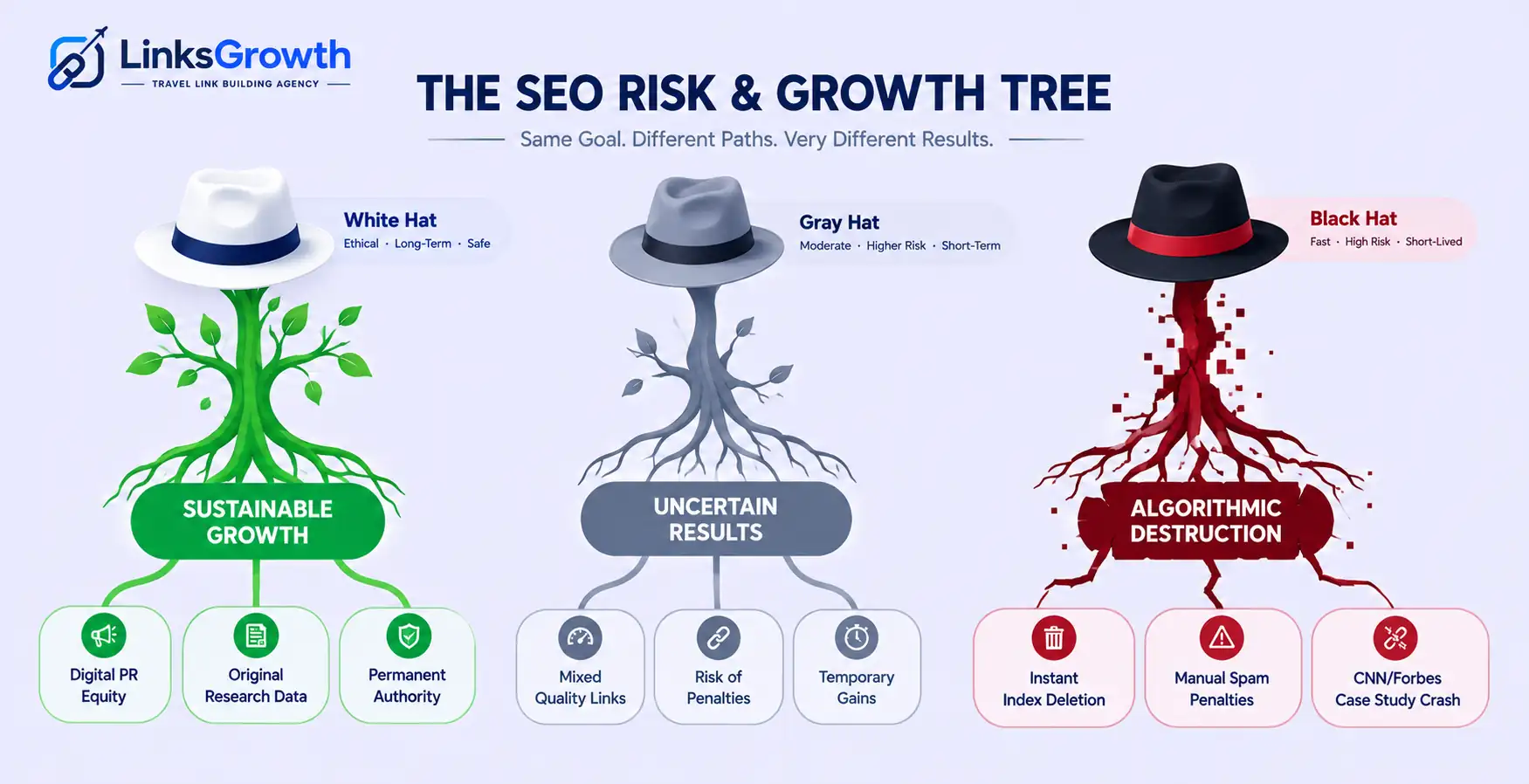
Not every link building tactic falls cleanly into “safe” or “dangerous.” It helps to think of it as a spectrum.
White hat techniques include genuine guest posting on relevant sites, digital PR that earns organic media coverage, resource page inclusions, broken link building, and original research that other sites cite naturally. Nothing here violates Google’s guidelines, and nothing here would need to be hidden from anyone.
Grey hat techniques sit in a more uncomfortable middle ground. Buying a “sponsored” post but not disclosing it, joining large-scale link exchange networks, or using PR distribution services purely to generate backlinks without any real editorial interest fall here. These tactics don’t always trigger an immediate penalty, but they carry real risk, and that risk compounds with every spam update Google ships.
Black hat techniques are the ones explicitly named in Google’s own spam policies: private blog networks (PBNs) built purely to pass authority, paid links with manipulated anchor text and no disclosure, comment spam, link farms, and what Google now formally calls “site reputation abuse” — renting space on a trusted, high-authority domain to publish unrelated content purely to borrow its ranking power. This last one is worth pausing on, because it’s been one of the most aggressively enforced policies of the past two years. Forbes Advisor’s affiliate operation and CNN’s Underscored product-review section were both hit hard once Google’s enforcement caught up with them — in Underscored’s case, dropping to a small fraction of its previously indexed pages almost overnight.
The line between these categories isn’t always obvious in the moment, which is exactly why so many businesses end up burned by an agency promising fast results. If a tactic requires payment specifically for a link with a chosen anchor text, or relies on a network of low-quality sites that exist purely to link out, it’s black hat — regardless of how it’s marketed.
It’s a fair question. If Google’s algorithms keep getting smarter, shouldn’t links matter less over time, not more?
The honest answer is that links haven’t become less important — they’ve become harder to fake. SpamBrain, Google’s AI-based spam detection system, doesn’t just look at whether a link exists. It evaluates the pattern behind it: where it came from, how it was acquired, whether the surrounding content is genuine, and whether the linking site itself shows signs of existing purely to manipulate rankings.
A few developments from the past two years explain exactly why white hat link building keeps winning:
The spam update cadence has tightened dramatically. Seven confirmed rollouts since October 2023, with five of those landing in 2026 alone at a pace of roughly once every six to seven weeks. Each one is effectively an upgrade to SpamBrain’s detection capability. A manipulative link scheme that worked in early 2025 has a shrinking window before it’s identified and devalued — sometimes silently, with Google simply discounting the artificial signal rather than issuing a visible penalty.
Site reputation abuse enforcement has real teeth now. Google formally announced this policy in March 2024 and has enforced it with increasing aggression through 2024 and into 2026. The pattern is always the same: a trusted domain hosts unrelated third-party content — payday loans on an educational site, casino reviews on a medical portal — purely to exploit the host domain’s authority. When caught, the penalty doesn’t just hit the offending pages; it can devalue the entire practice retroactively.
Scaled content abuse now explicitly covers AI-generated content. Google’s position, restated clearly through 2025 and 2026, is that publishing content at scale purely to manipulate rankings is spam — whether a human or an AI model produced it. This matters directly for link building, because it closes off an entire category of shortcut: mass-producing thin, AI-written guest posts or resource pages purely to house outbound links. The safeguard, according to Google’s own guidance, is genuine expertise and original input — which is precisely the standard behind E-E-A-T (Experience, Expertise, Authoritativeness, Trustworthiness).
Historical precedent shows this isn’t new — it’s just faster now. JC Penney’s 2011 link scheme, uncovered when a New York Times investigation flagged the retailer ranking first for terms it had no natural authority on, led to a collapse in rankings within hours once Google’s team confirmed the violation. Interflora saw something similar in 2013 after paid advertorial links were discovered, recovering only after the scheme was fully unwound. The mechanics haven’t changed in over a decade — what’s changed is the speed and scale at which SpamBrain can now detect the same patterns automatically, rather than waiting for a manual investigation.
Put simply: white hat link building keeps working because it was never dependent on Google failing to notice it. It works with the grain of how search quality is measured, not against it.
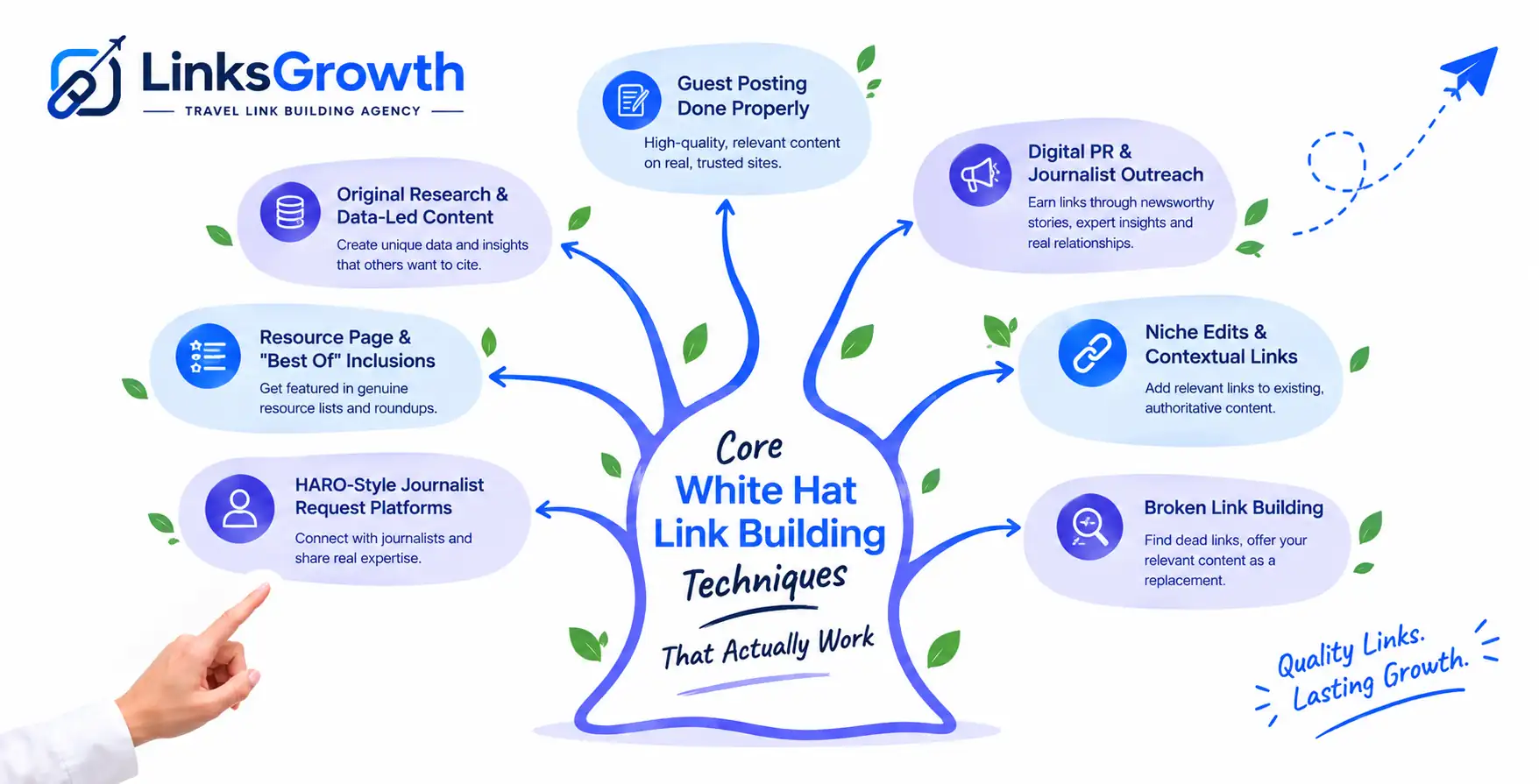
Not every legitimate technique performs equally well in 2026. Here’s what’s genuinely effective right now, and why.
Guest posting still works — but the version that works in 2026 looks very different from the mass-outreach guest posting of a decade ago. A legitimate approach means pitching genuinely useful, original content to publications your audience actually reads, written by someone with real expertise in the subject, placed through a real editorial relationship rather than a paid exchange. The difference between this and a black hat guest posting network is entirely about relevance, quality, and disclosure.
Digital PR has become one of the strongest white hat link building strategies precisely because it produces exactly the kind of link Google trusts most: one a journalist chose to include because the underlying story, data, or expert commentary was genuinely newsworthy. This includes proactive outreach around original research, expert commentary on breaking industry news, and building relationships with journalists who cover your sector regularly — not one-off pitches sent to a scraped media list.
A niche edit — adding a relevant link into existing, already-published content on a genuinely authoritative site — remains effective specifically because it sidesteps the scaled-content problem entirely. There’s no new thin page created purely to house a link; the placement lives within content that already earned its own authority and relevance. The key word here is relevant: a niche edit only holds up if the surrounding content and the linked page are genuinely related.
This technique hasn’t lost any effectiveness: identifying dead links on relevant resource pages, then offering your own working, genuinely useful page as a replacement. It’s slow, it doesn’t scale into the hundreds, and that’s exactly why it still works — every placement requires a real human decision at the other end.
Being added to a curated resource list or industry roundup remains one of the cleanest white hat backlink sources available, provided the resource is genuinely useful enough to deserve inclusion on its own merits.
Creating something genuinely citable — original survey data, an industry benchmark report, a proprietary dataset — continues to be one of the most durable link building strategies precisely because it can’t be faked at scale. Other sites link to original data because it’s useful to their own readers, not because anyone asked them to.
Services connecting journalists seeking expert quotes with genuine subject-matter experts remain a legitimate, scalable way to earn editorial links and mentions in high-authority publications, provided the expertise offered is real and the responses aren’t templated or AI-generated at volume.
This is where most businesses actually get burned — not by understanding white hat principles poorly, but by hiring a link building service that claims to follow them while doing the opposite behind the scenes.
Red flags worth taking seriously:
Green flags that indicate a genuine white hat link building service:
If an agency can’t clearly explain why a specific site agreed to link to you, that’s usually the clearest sign something isn’t fully white hat.
A few trends are already shaping where this discipline heads next, and none of them make white hat link building less relevant — if anything, they raise the bar for what “genuine” needs to mean.
AI content detection is getting more sophisticated on both sides. As more content gets produced with AI assistance, the sites and publishers worth earning links from are becoming more selective about what they accept, which naturally filters out low-effort, mass-produced pitches in favour of genuinely expert contributions.
Entity and topical authority are becoming as important as the link itself. Google’s systems increasingly evaluate whether a site is a recognised, consistent authority on a topic — not just whether it has a high domain rating. This rewards a focused, consistent white hat link building strategy over scattershot placements across unrelated niches.
Unlinked brand mentions are gaining real weight. As Google’s entity recognition improves, being mentioned by name — even without a hyperlink — appears to carry increasing signal value, which shifts some digital PR strategy toward earning genuine media coverage and away from insisting every mention include a link.
Original, first-party data remains the most durable linkable asset. As AI-generated content floods the web, genuinely original research, survey data, and expert analysis stand out more, not less, because they’re the one category of content that can’t be synthetically replicated at scale.
Seven spam updates in under three years haven’t slowed link building down — they’ve simply made the shortcuts stop working. White hat link building was never a slower, more cautious alternative to “real” SEO. It’s the version of link building that was built to survive exactly the kind of scrutiny Google is now applying at scale, automatically, and permanently.
The businesses seeing genuine, lasting results in 2026 aren’t the ones that found a clever workaround. They’re the ones that partnered with a link building service that never needed one in the first place — earning placements through relevance, real relationships, and content actually worth linking to.
That’s a slower path than a bulk link package promising fifty backlinks a month. It’s also the only one still standing after seven rounds of Google trying to catch everyone who took the shortcut instead.
Yes — arguably more than ever. As Google’s spam detection has become faster and more automated, the gap between white hat and black hat outcomes has widened rather than narrowed. A manipulative link scheme might work for a few months before an update catches up with it; a genuinely earned backlink from a relevant, authoritative site keeps contributing value indefinitely, since there’s no artificial signal for SpamBrain to eventually discount.
Realistically, most businesses start seeing measurable ranking movement within three to six months, with compounding results building over twelve months and beyond. This is slower than what a black hat scheme might promise, but it’s also the timeline that doesn’t come with the risk of a sudden collapse once an algorithm catches up. Anyone promising significant ranking changes within a few weeks is either overselling normal SEO timelines or using tactics that won’t hold up.
A genuine white hat link building service scopes work around your specific industry, target publications, and realistic opportunities — meaning the number of links secured each month will vary naturally based on what’s genuinely achievable. A “backlink package” that promises a fixed number of links at a fixed price, regardless of niche or relevance, is almost always relying on a network of low-quality or manufactured sites to hit that number consistently, since genuinely relevant placements simply can’t be guaranteed at a fixed volume.
Guest posting itself isn’t penalized — Google has been explicit about this for years. What gets penalized is guest posting used purely to manipulate rankings: content published on low-quality sites that exist mainly to sell placements, keyword-stuffed anchor text, or guest posts with no genuine editorial standard behind them. A well-written, genuinely useful guest post on a relevant site, placed through a real editorial process, remains entirely safe and effective.
Increasingly, yes. While an unlinked mention doesn’t pass PageRank the way a hyperlink does, Google’s entity-recognition systems are demonstrably better at associating a brand name with a domain even without a direct link. A comprehensive white hat strategy in 2026 treats earned media coverage and brand mentions as valuable in their own right, not just as a fallback when a link wasn’t secured.
Did you find this article useful?